Bring out the nature and significance of Bhakti Movements in Medieval India.
In short
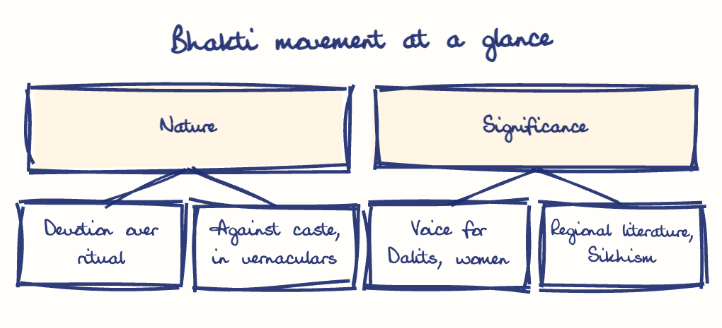
The Bhakti Movement was a devotional movement emphasising personal love for God over ritual, rejecting caste, using vernacular languages and blending Hindu and Islamic ideas. Beginning with the Alvars and Nayanars and spreading through saints like Kabir, Meera Bai and Tulsidas, it promoted social equality, literary renaissance and communal harmony.
Model answer
Ghissu Editorial · Verified 4 Oct 2026 · 291 words
Personal Devotion and Vernacular Languages
Saints like the Alvars and Nayanars emphasized direct emotional bonds with deities, composing hymns in Tamil, Marathi, Hindi, and Bengali to reach the masses. This vernacularization democratized spiritual knowledge beyond Sanskrit elites.
Rejection of Caste and Ritualism
Saints like Ramananda and Kabir taught that devotion was open to all regardless of caste, challenging Brahmanical authority and priestly ritual. This gave marginalised communities and women a spiritual voice and dignity.
Syncretism and Social Harmony
Kabir and Guru Nanak blended Hindu and Islamic ideas, promoting tolerance during the Sultanate period and laying the groundwork for Sikhism. This helped spread Bhakti ideals widely, fostering social cohesion.
Promote Bhakti Literature and Vernacular Arts
Integrate Bhakti poetry into education and support folk and classical music through cultural initiatives. This preserves the movement’s legacy and promotes values of inclusivity.
Empower Marginalized Groups
Use Bhakti’s egalitarian ethos to design inclusive social programs that recognize the cultural and spiritual contributions of oppressed communities, fostering social justice.
This model answer is indicative and the model can make mistakes; please verify key facts independently.
Practise this question
1Get the answer sheet
Sized for this question.
2Write your answer
Timed, by hand.
3Get it marked
Your score and what to fix.
This chapter in the exam
Early Medieval & Medieval India - Pallavas to Cholas, Delhi Sultanate, Bhakti & Sufi, Kakatiya-Vijayanagara-Bahmani-Qutubshahi13 questions
Asked in 8 of 8 sittings since 2008
Most tested: Medieval cultural history through Bhakti/Sufi and South Indian dynastic contributions to religion, architecture, and social organization.
- 2025Describe the contributions of the Chalukya rulers of Kalyani in the fields of sculpture, architecture, and literature.
- 2025Describe the characteristics of the Sufi movement and assess its impact on Indian culture.
All 13 questions, sorted by sub-topic, with model answers and practice.
Question from the official APPSC Group-I Mains 2008 paper. Answer written by Ghissu's engine and checked against our editorial standards. Found an error? Tell us and we correct it within 48 hours.