Describe the contributions of the Chalukya rulers of Kalyani in the fields of sculpture, architecture, and literature.
In short
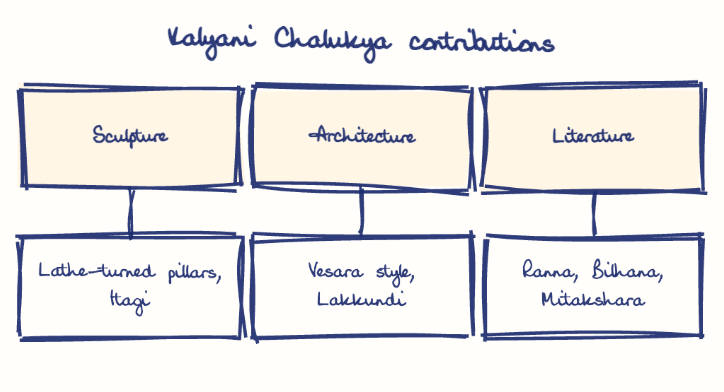
The Chalukyas of Kalyani pioneered the Vesara temple style blending Nagara and Dravida forms, with lathe-turned pillars and ornate carvings at Lakkundi, Itagi and Gadag, and patronised Kannada and Sanskrit literature. Their court produced Ranna's Saahasabheema Vijayam, Bilhana's Vikramankadeva Charita and Vijnanesvara's Mitakshara.
Model answer
Ghissu Editorial · Verified 4 Oct 2026 · 259 words
Intricate Sculptures
Their stone carvings, such as Ramayana panels at Trikuteshwara Temple, and lathe-turned pillars at Mahadeva Temple, Itagi, demonstrate refined craftsmanship and religious pluralism. These sculptures depict Shaivism, Vaishnavism, and Jainism themes, reflecting the era’s spiritual diversity.
Vesara Architectural Style
They developed the Vesara style, combining Nagara and Dravida elements, exemplified by Kasivisvesvara Temple, Lakkundi, and Mahadeva Temple, Itagi, influencing Deccan temple architecture. This style marked a transition and inspired later Hoysala architecture.
Kannada and Sanskrit1 Literature
Royal patronage supported Kannada poets like Ranna, author of Saahasabheema Vijayam, and Sanskrit works such as Bilhana’s Vikramankadeva Charita, chronicling Chalukya rulers’ exploits and reflecting cultural and political aspirations.
Scholarly Treatises
Works like Vijnanesvara’s Mitakshara and Somesvara III’s Manasollasa shaped jurisprudence and courtly learning, with Mitakshara becoming a foundational text in Hindu law.
Cultural Tourism and Education
Develop sustainable tourism circuits around key sites like Lakkundi and Gadag to boost local economies and cultural awareness. Integrate detailed studies of Chalukya heritage into school and university curricula to foster cultural pride.
This model answer is indicative and the model can make mistakes; please verify key facts independently.
Practise this question
1Get the answer sheet
Sized for this question.
2Write your answer
Timed, by hand.
3Get it marked
Your score and what to fix.
This chapter in the exam
Early Medieval & Medieval India - Pallavas to Cholas, Delhi Sultanate, Bhakti & Sufi, Kakatiya-Vijayanagara-Bahmani-Qutubshahi13 questions
Asked in 8 of 8 sittings since 2008
Most tested: Medieval cultural history through Bhakti/Sufi and South Indian dynastic contributions to religion, architecture, and social organization.
- 2025Describe the characteristics of the Sufi movement and assess its impact on Indian culture.
- 2023Examine the manner in which the Chola village administration had contributed to the growth of village autonomy as indicated by the Uttaramerur/Uttaramallur inscriptions.
All 13 questions, sorted by sub-topic, with model answers and practice.
Question from the official APPSC Group-I Mains 2025 paper. Answer written by Ghissu's engine and checked against our editorial standards. Found an error? Tell us and we correct it within 48 hours.