Discuss the social and economic conditions under the Vijayanagar rulers.
In short
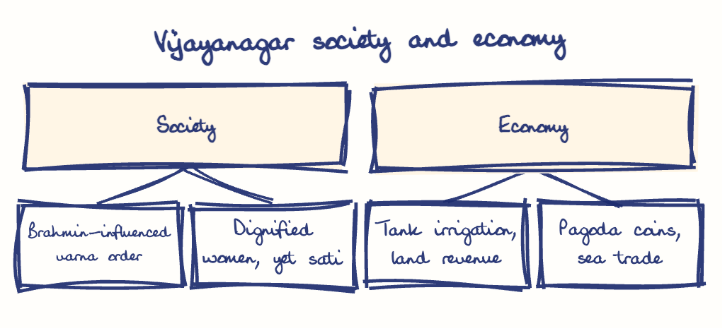
Vijayanagar society was hierarchical and varna-based, with Brahmins in key administrative roles and women enjoying relative dignity despite sati, while its economy rested on tank-irrigated agriculture, thriving trade and gold coinage. The amara-nayaka system tied military service to land revenue, and temples acted as economic centres.
Model answer
Ghissu Editorial · Verified 4 Oct 2026 · 263 words
Brahminical Hierarchy and Social Mobility1
Brahmins dominated administration and military roles (Madhava, Sayana), reinforcing Varnashrama Dharma, while rulers without an established Kshatriya lineage claimed Kshatriya status, blending tradition with social mobility and challenging orthodox caste roles.
Trade and Monetary System
Vijayanagar thrived on spice, textile, and precious stone trade; maritime commerce involved Persians, Arabs, Portuguese; coinage included gold, silver, and copper coins like pagoda and fanam, facilitating regional and international trade.
Amara-Nayaka Military-Economic System
Land grants to military chiefs linked defense and economy, creating regional power centers that sometimes challenged central authority, illustrating decentralized governance.
Temples as Economic and Social Hubs
Religious patronage supported economy and social order, with temples owning land, acting as wealth centers, supporting artisans and pilgrims, and distributing prasadam, thus integrating religion with economic life.
Varna System Shaping Economy
Brahmins in administration, Vaishyas in trade, peasants in agriculture created an interdependent social-economic structure sustaining stability and governance.
Urban Prosperity and Taxation
Wealthy urban classes adorned with precious stones funded public services including policing through taxes on professions and even prostitutes, showing organized economic management and social diversity.
This model answer is indicative and the model can make mistakes; please verify key facts independently.
Sources
Practise this question
1Get the answer sheet
Sized for this question.
2Write your answer
Timed, by hand.
3Get it marked
Your score and what to fix.
This chapter in the exam
Early Medieval & Medieval India - Pallavas to Cholas, Delhi Sultanate, Bhakti & Sufi, Kakatiya-Vijayanagara-Bahmani-Qutubshahi13 questions
Asked in 8 of 8 sittings since 2008
Most tested: Medieval cultural history through Bhakti/Sufi and South Indian dynastic contributions to religion, architecture, and social organization.
- 2025Describe the contributions of the Chalukya rulers of Kalyani in the fields of sculpture, architecture, and literature.
- 2025Describe the characteristics of the Sufi movement and assess its impact on Indian culture.
All 13 questions, sorted by sub-topic, with model answers and practice.
Question from the official APPSC Group-I Mains 2008 paper. Answer written by Ghissu's engine and checked against our editorial standards. Found an error? Tell us and we correct it within 48 hours.