Discuss the socio-religious conditions and the development of Telugu language and literature during the Satavahana period.
In short
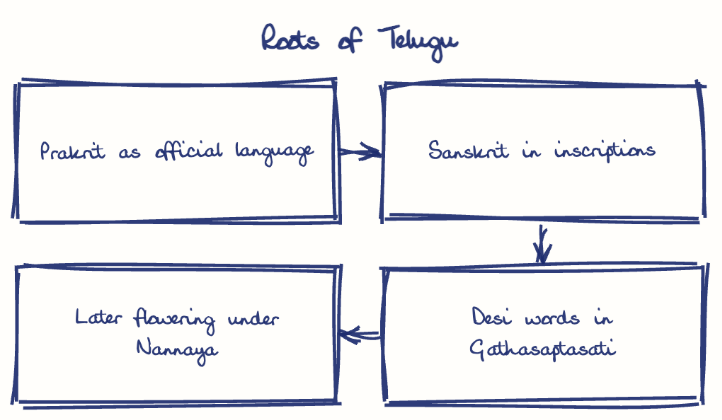
Satavahana society blended Brahmanical revival and Vedic sacrifice with Buddhist patronage at Amaravati and relative social openness, under a multilingual court using Prakrit, Sanskrit and Desi speech. Telugu's roots lie in this Desi substratum, seen in Desi words in Hala's Gathasaptasati and the word "Nagabu" in an Amaravati inscription.
Model answer
Ghissu Editorial · Verified 4 Oct 2026 · 266 words
Brahmanical Revival
Satakarni I performed grand Vedic sacrifices such as Ashvamedha and Rajasuya, recorded in the Naneghat inscription, and Gautamiputra Satakarni was hailed as 'Ekabrahmana' in the Nasik prasasti, reinforcing the Vedic social order. Their patronage strengthened Brahminical dominance and the Varna system.
Buddhist Flourishing
Mahayana Buddhism, led by Acharya Nagarjuna, thrived under royal patronage; centers like Amaravati became major pilgrimage and learning hubs, reflecting religious pluralism. This coexistence fostered syncretism and intellectual exchange.
Early Telugu Roots and Literary Continuity
Desi words in texts like Gathasaptasati and inscriptions indicate early Telugu evolution; this linguistic foundation influenced later classical Telugu literature by poets like Nannaya. The Satavahana period thus laid the substratum for Telugu’s literary tradition.
Religious and Cultural Integration
Buddhist monasteries and Vedic altars established under Satavahanas became enduring institutions in Andhra Pradesh, while multilingual patronage fostered cultural synthesis. These centers promoted learning and religious dialogue.
Artistic Achievements
Rock-cut caves, chaityas, and viharas from this era symbolize the Satavahana’s religious pluralism and artistic legacy. Their architectural innovations influenced subsequent Deccan art and culture.
This model answer is indicative and the model can make mistakes; please verify key facts independently.
Practise this question
1Get the answer sheet
Sized for this question.
2Write your answer
Timed, by hand.
3Get it marked
Your score and what to fix.
This chapter in the exam
Andhra - Ancient16 questions
Asked in 8 of 8 sittings since 2008
Most tested: Satavahana socio-religious and cultural life, especially society, religion, and literature.
- 2025How did far trade routes contribute to the exchange of Buddhist ideas in ancient Andhra?
- 2025What are the various stories about the origins of Andhra people and the Andhra language?
All 16 questions, sorted by sub-topic, with model answers and practice.
Question from the official APPSC Group-I Mains 2008 paper. Answer written by Ghissu's engine and checked against our editorial standards. Found an error? Tell us and we correct it within 48 hours.