Examine the objectives, methods and the impact of the Moderates vis-a-vis the Extremists during the course of the Indian Freedom Struggle from 1885 to 1920.
In short
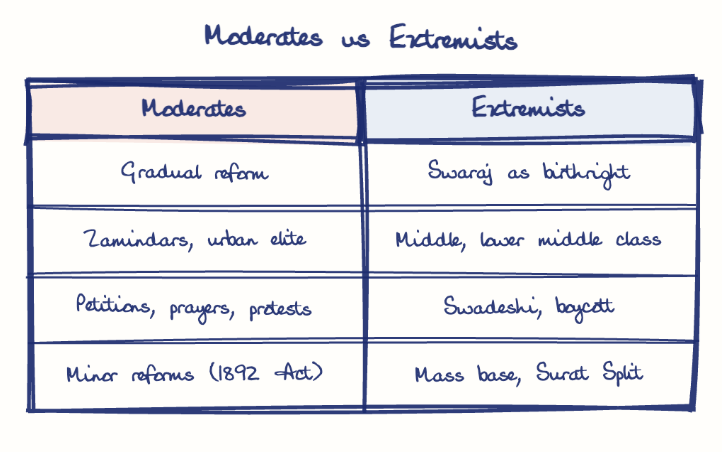
Moderates sought gradual reform through petitions and constitutional agitation, while Extremists demanded Swaraj through Swadeshi, boycott and mass mobilisation, as in Tilak's "Swaraj is my birthright". Moderates won limited gains like the Indian Councils Act 1892, Extremists widened the base, and their rift caused the 1907 Surat Split.
Model answer
Ghissu Editorial · Verified 4 Oct 2026 · 274 words
Moderates’ Constitutional Reform
They aimed for gradual political reforms within British frameworks, supporting the Indian Councils Act (1892) and relying on petitions and protests ("3 Ps") to appeal to British justice, as seen in Dadabhai Naoroji’s Drain Theory. Their base was mainly zamindars and urban elites inspired by Western liberalism, believing in dialogue and British fairness.
Extremists’ Swaraj Demand and Mass Mobilization
Extremists, inspired by Tilak’s slogan "Swaraj is my birthright," demanded full self-rule, rejecting British sovereignty. They used boycotts, Swadeshi, and mass rallies, notably during the 1905 Bengal Swadeshi Movement, mobilizing the educated middle classes and invoking Indian cultural pride. They promoted indigenous industries and national education to foster self-reliance.
Moderates’ Limited Gains
They raised political awareness and secured minor legislative reforms but failed to mobilize the masses or gain substantial power, leading to criticism of "political mendicancy." Their faith in elite leadership limited their reach and effectiveness.
This model answer is indicative and the model can make mistakes; please verify key facts independently.
Sources
Practise this question
1Get the answer sheet
Sized for this question.
2Write your answer
Timed, by hand.
3Get it marked
Your score and what to fix.
This chapter in the exam
Indian Nationalism in Three Phases; Independence, Partition and After22 questions
Asked in 8 of 8 sittings since 2008
Most tested: Gandhian mass movements and their impact, alongside peasant mobilisation and communalism/partition.
- 2025Discuss the role and contributions of the moderate leaders of Congress from 1885 to 1905.
- 2025Describe the major movements led by Mahatma Gandhi between 1920 and 1947.
All 22 questions, sorted by sub-topic, with model answers and practice.
Question from the official APPSC Group-I Mains 2008 paper. Answer written by Ghissu's engine and checked against our editorial standards. Found an error? Tell us and we correct it within 48 hours.