Discuss the role and contributions of the moderate leaders of Congress from 1885 to 1905.
In short
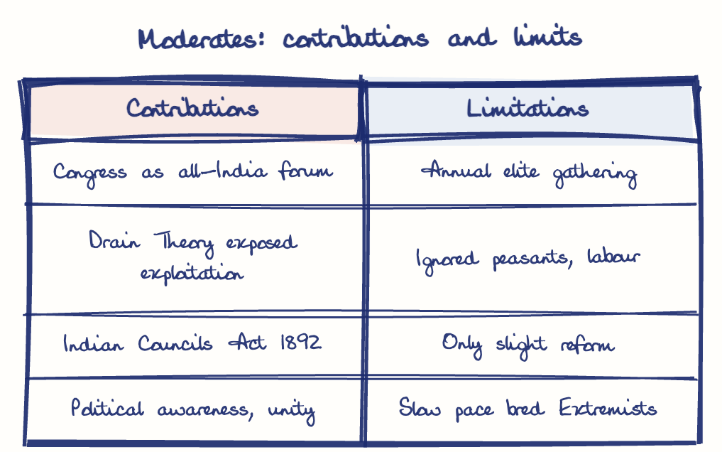
The Moderates (1885-1905), led by Dadabhai Naoroji, Pherozeshah Mehta and Gokhale, built the Congress into an all-India forum using petitions and constitutional agitation, though their elite base limited mass reach. They exposed economic exploitation through the Drain Theory and secured the Indian Councils Act of 1892.
Model answer
Ghissu Editorial · Verified 4 Oct 2026 · 262 words
Constitutional Nationalism Architects
Dadabhai Naoroji, Pherozeshah Mehta, and Gopal Krishna Gokhale led Congress as a platform for constitutional agitation, focusing on petitions and resolutions to influence British policy.
Economic Critique and Drain Theory
Naoroji’s Drain Theory highlighted British economic exploitation, linking political demands with economic justice.
Institutionalizing Nationalist Politics
Moderates established the Indian National Congress as the first all-India political forum and secured reforms like the Indian Councils Act 1892, expanding Indian legislative representation.
Political Education and Unity
They aimed to politically educate Indians and foster national unity across regions and communities.
Limitations of Elitism
Their English-educated, property-owning base limited mass mobilization and grassroots engagement.
Catalyst for Radicalization
The slow pace of reforms under moderates led to the rise of Extremists like Bal Gangadhar Tilak demanding assertive action.
Foundation for National Unity
Moderates laid groundwork for pan-Indian political identity and constitutional agitation culture.
Need for Inclusive Leadership
Future movements required bridging elite and grassroots interests and combining constitutional methods with mass mobilization.
Focus on Socio-Economic Issues
Integrating economic justice and social reforms was essential to address marginalized groups’ concerns.
This model answer is indicative and the model can make mistakes; please verify key facts independently.
Practise this question
1Get the answer sheet
Sized for this question.
2Write your answer
Timed, by hand.
3Get it marked
Your score and what to fix.
This chapter in the exam
Indian Nationalism in Three Phases; Independence, Partition and After22 questions
Asked in 8 of 8 sittings since 2008
Most tested: Gandhian mass movements and their impact, alongside peasant mobilisation and communalism/partition.
- 2025Describe the major movements led by Mahatma Gandhi between 1920 and 1947.
- 2023Explain the factors that led to the peasant movement in India and examine its impact on the national movement in India.
All 22 questions, sorted by sub-topic, with model answers and practice.
Question from the official APPSC Group-I Mains 2025 paper. Answer written by Ghissu's engine and checked against our editorial standards. Found an error? Tell us and we correct it within 48 hours.