Describe the major movements led by Mahatma Gandhi between 1920 and 1947.
In short
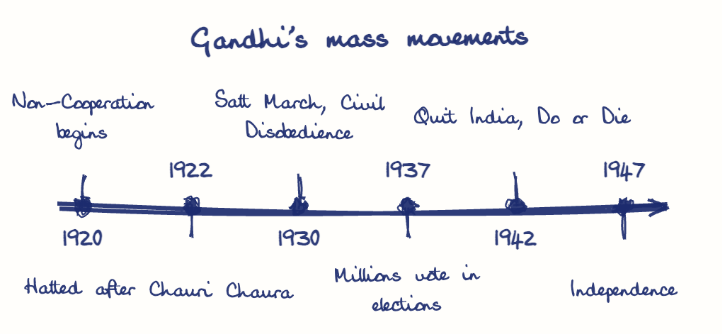
Between 1920 and 1947 Gandhi led three major mass movements: Non-Cooperation (1920-1922), Civil Disobedience (1930-1934) beginning with the Salt March, and Quit India (1942) with its call of "Do or Die". Together they made the Congress a mass organisation and set the stage for independence in 1947.
Model answer
Ghissu Editorial · Verified 4 Oct 2026 · 236 words
Non-Cooperation Movement
Triggered by the Rowlatt Act and Jallianwala Bagh massacre, it promoted boycott of British goods and institutions, Khadi, and Hindu-Muslim unity, involving peasants, workers, and women.
Civil Disobedience Movement
Initiated by the Salt March (1930), it involved peaceful law-breaking, refusal to pay taxes, and mass participation of women and peasants, broadening the base of the national movement.
Quit India Movement
Launched in 1942 with the “Do or Die” slogan, it demanded immediate British exit, using mass protests and strikes despite brutal repression and imprisonment of leaders.
Non-Cooperation Movement
It transformed the Congress into a mass organization and promoted social reforms like eradicating untouchability, despite ending after Chauri Chaura.
Civil Disobedience Movement
It revitalized the freedom struggle, led to the Gandhi-Irwin Pact, and brought international attention to India’s cause.
Quit India Movement
Though suppressed, it weakened British authority and united diverse groups, setting the stage for independence.
Strengthen Gandhian Values
Promote non-violence and trusteeship principles for governance and social welfare.
Revive Constructive Programs
Support Swadeshi and Gram Swaraj ideals for sustainable development.
This model answer is indicative and the model can make mistakes; please verify key facts independently.
Practise this question
1Get the answer sheet
Sized for this question.
2Write your answer
Timed, by hand.
3Get it marked
Your score and what to fix.
This chapter in the exam
Indian Nationalism in Three Phases; Independence, Partition and After22 questions
Asked in 8 of 8 sittings since 2008
Most tested: Gandhian mass movements and their impact, alongside peasant mobilisation and communalism/partition.
- 2025Discuss the role and contributions of the moderate leaders of Congress from 1885 to 1905.
- 2023Explain the factors that led to the peasant movement in India and examine its impact on the national movement in India.
All 22 questions, sorted by sub-topic, with model answers and practice.
Question from the official APPSC Group-I Mains 2025 paper. Answer written by Ghissu's engine and checked against our editorial standards. Found an error? Tell us and we correct it within 48 hours.