Examine the salient features of the Indian Foreign Policy during the post-Independence period upto 1989.
In short
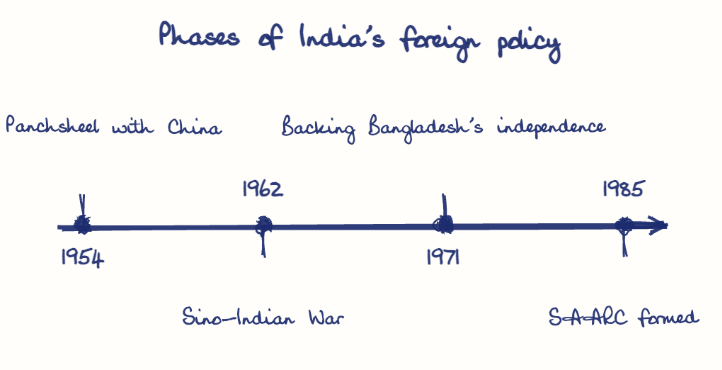
India's foreign policy up to 1989 rested on non-alignment and strategic autonomy, anti-colonialism, Panchsheel and regional cooperation, balancing idealism with realism. It moved from Nehruvian idealism to closer Soviet ties after the 1962 war, support for Bangladesh in 1971, and the founding of SAARC in 1985.
Model answer
Ghissu Editorial · Verified 4 Oct 2026 · 287 words
Non-Alignment
India refused to join either Cold War bloc and co-founded the Non-Aligned Movement (1961), preserving its strategic autonomy.
Decolonization and Anti-Imperialism
India actively supported liberation movements in Asia and Africa, reflecting its anti-colonial stance. It positioned itself as a moral leader against imperialism in international forums like the United Nations.
Idealism and Panchsheel (1947-1962)
Nehru’s era emphasized nuclear disarmament and peaceful coexistence, exemplified by the 1954 Panchsheel Agreement with China. However, the 1962 Sino-Indian War exposed strategic vulnerabilities and led to criticism of India’s defense preparedness.
Realism and Soviet Alignment (1962-1977)
Post-1962, India deepened ties with the Soviet Union to counterbalance China and Pakistan, reflecting pragmatic non-alignment. India’s support for Bangladesh’s independence in 1971 asserted its regional influence and commitment to self-determination.
Regional Focus and Pragmatism (1977-1989)
India fostered regional cooperation through SAARC’s establishment in 1985, aiming to build South Asian stability. It also cautiously engaged in economic diplomacy, laying groundwork for later liberalization efforts.
Strengthen Strategic Autonomy
Invest in defense modernization and indigenous technology to reduce import dependence and enhance independent decision-making.
Enhance Regional Engagement
Build deeper economic and security partnerships within South Asia to foster stability and counter external influences.
This model answer is indicative and the model can make mistakes; please verify key facts independently.
Practise this question
1Get the answer sheet
Sized for this question.
2Write your answer
Timed, by hand.
3Get it marked
Your score and what to fix.
This chapter in the exam
Indian Nationalism in Three Phases; Independence, Partition and After22 questions
Asked in 8 of 8 sittings since 2008
Most tested: Gandhian mass movements and their impact, alongside peasant mobilisation and communalism/partition.
- 2025Discuss the role and contributions of the moderate leaders of Congress from 1885 to 1905.
- 2025Describe the major movements led by Mahatma Gandhi between 1920 and 1947.
All 22 questions, sorted by sub-topic, with model answers and practice.
Question from the official APPSC Group-I Mains 2008 paper. Answer written by Ghissu's engine and checked against our editorial standards. Found an error? Tell us and we correct it within 48 hours.