What was the contribution of the Socio-religious Reform Movements of the 19th century for the upliftment of women in Modern India ?
In short
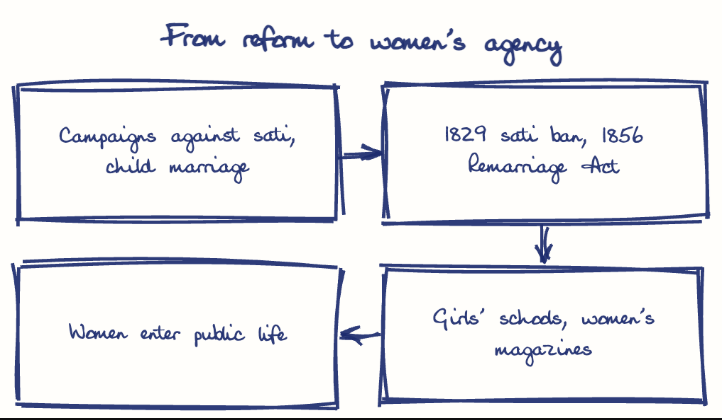
Nineteenth-century reform movements uplifted women by campaigning against sati and child marriage, promoting girls' education and championing widow remarriage. Their work produced the 1829 ban on sati and the Hindu Widow Remarriage Act (1856), while in Andhra Kandukuri Viresalingam Pantulu spread women's education and widow remarriage through the Telugu press.
Model answer
Ghissu Editorial · Verified 4 Oct 2026 · 281 words
Brahmo Samaj’s Rational Reform
Raja Ram Mohan Roy led opposition to sati and child marriage, and later Brahmo leaders advocated widow remarriage and women’s education, thus initiating a rational critique of religious orthodoxy that legitimized gender inequality.
Arya Samaj’s Vedic Revivalism
Dayanand Saraswati condemned polygamy and purdah, promoting women’s education for social regeneration and encouraging a return to Vedic principles that supported gender justice.
Women’s Education and Vernacular Media
Girls’ schools such as the Bethune School (1849) and magazines like *Bamabodhini Patrika* fostered feminist discourse and intellectual growth, while vernacular press expanded reformist ideas to wider audiences.
Legal Reforms and Advocacy
The abolition of sati (1829) and Hindu Widow Remarriage Act (1856) reflected reformers’ success; Ishwar Chandra Vidyasagar championed widow remarriage, challenging orthodox prohibitions and influencing social attitudes.
Foundation for Legal Protections
These movements paved the way for constitutional gender equality and influenced the *Towards Equality* report (1974), which highlighted women’s emerging role in society.
Limitations and Resistance
Benefits were mostly for upper-caste urban women; rural and lower-caste women faced marginalization and orthodox resistance persisted, limiting the pace of change.
This model answer is indicative and the model can make mistakes; please verify key facts independently.
Practise this question
1Get the answer sheet
Sized for this question.
2Write your answer
Timed, by hand.
3Get it marked
Your score and what to fix.
This chapter in the exam
British Rule 1757-1856, the 1857 Revolt, Socio-Religious Reform & the Rise of Nationalism20 questions
Asked in 8 of 8 sittings since 2008
Most tested: Colonialism’s impact on Indian society/economy and reform-led social uplift, especially untouchability and caste reform.
- 2025What do you understand by the Permanent Settlement, and what impact did it have on Indian society? Comment.
- 2025What do you understand by the 'safety valve' theory? Explain it in the context of the Indian National Congress?
All 20 questions, sorted by sub-topic, with model answers and practice.
Question from the official APPSC Group-I Mains 2008 paper. Answer written by Ghissu's engine and checked against our editorial standards. Found an error? Tell us and we correct it within 48 hours.