Do you agree with the view that functions are given to the States while resources are with the Centre ?
In short
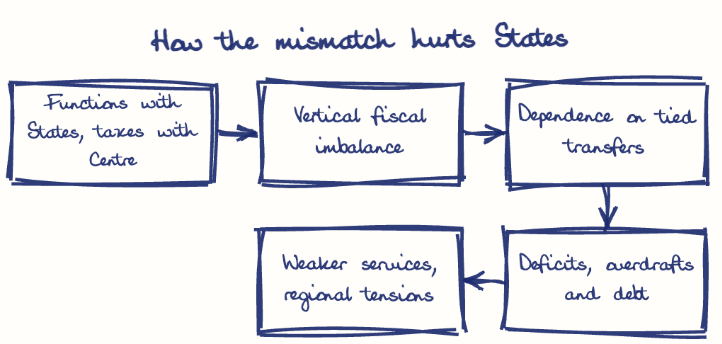
The view is largely accurate: the Seventh Schedule gives States heavy duties in health, education and police, while the Centre controls buoyant taxes like income tax and customs, creating a vertical fiscal imbalance. Finance Commission devolution under Article 280 partly corrects it, but conditional grants keep States dependent.
Model answer
Ghissu Editorial · Verified 4 Oct 2026 · 281 words
Functional Distribution
Article 246 and the Seventh Schedule allocate social sector functions like health and education primarily to States, ensuring functional autonomy. States also manage police and local governance, reflecting their key role in welfare.
State Dependence and Audit Evidence
Andhra Pradesh CAG 2025 audit shows gaps in welfare, education, and health linked to resource shortfalls and delayed fund transfers. This dependence weakens States’ ability to plan and implement policies effectively.
Political Tensions
Central control fuels demands like Special Category Status and river water disputes in Andhra Pradesh, straining cooperative federalism3. The use of Article 356 and control over All India Services further dilute State autonomy.
Fiscal Deficits and Debt
States face deficits and debt burdens due to limited revenue sources, as seen in Andhra Pradesh’s financial stress. Reliance on market borrowings increases debt servicing costs, reducing funds for development.
Finance Commission4 Reform
Strengthen the Finance Commission as a permanent, independent body with State input to ensure fair resource sharing. The Sarkaria Commission recommended this to balance authority and resources effectively.
Enhance State Fiscal Autonomy
Expand States’ taxation powers and reduce conditionalities on grants to empower them financially, enabling better governance and development outcomes.
This model answer is indicative and the model can make mistakes; please verify key facts independently.
Practise this question
1Get the answer sheet
Sized for this question.
2Write your answer
Timed, by hand.
3Get it marked
Your score and what to fix.
This chapter in the exam
Federal structure, Governor and distribution of powers17 questions
Asked in 8 of 8 sittings since 2008
Most tested: Centre–State balance and the extent of Union supremacy over States
- 2025The procedure of enacting a law from a bill differs at the Union and State levels, primarily to safeguard the interests of the Union Government in state legislation. Elucidate this aspect.
- 2025Although States have their separate list for law-making, this authority is not beyond the overarching legislative powers of the Parliament. Examine.
All 17 questions, sorted by sub-topic, with model answers and practice.
Question from the official APPSC Group-I Mains 2008 paper. Answer written by Ghissu's engine and checked against our editorial standards. Found an error? Tell us and we correct it within 48 hours.