Although States have their separate list for law-making, this authority is not beyond the overarching legislative powers of the Parliament. Examine.
In short
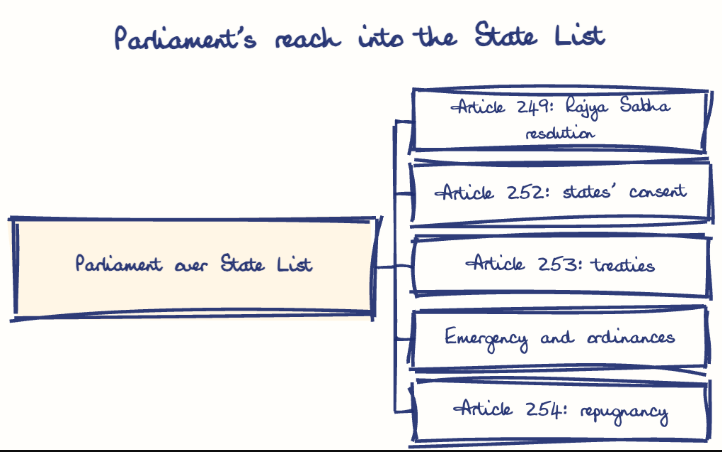
States legislate on their own State List, but Parliament's overarching powers reach into it through residuary powers (Article 248), national interest resolutions (Article 249), consent laws (Article 252), treaty implementation (Article 253) and emergencies. Under Article 249, a two-thirds Rajya Sabha resolution lets Parliament legislate on State subjects.
Model answer
Ghissu Editorial · Verified 4 Oct 2026 · 250 words
State List Exclusivity
States control 59 subjects like police and agriculture under the Seventh Schedule, ensuring regional autonomy.
Concurrent List and Residuary Powers
Both Parliament and States legislate on 52 subjects; Parliament holds residuary powers under Article 248, reinforcing Centre’s primacy.
Article 249 National Interest Clause
Parliament can legislate on State subjects with Rajya Sabha’s two-thirds majority resolution for national interest.
Article 252 Consent Legislation
Parliament legislates for consenting States, enabling uniform laws on inter-State issues, as with the Water (Prevention and Control of Pollution) Act, 1974.
Article 253 and Emergencies
Parliament can legislate on any subject to implement international treaties or during emergencies, extending its reach over State laws.
Harmonious Construction
Supreme Court balances Centre-State powers, as in State of West Bengal v. Union of India, upholding federalism.
Repugnancy Rule
Union laws prevail over conflicting State laws in Concurrent List unless presidential assent is granted.
Judicial Review
Courts ensure legislative powers comply with constitutional limits, protecting federal balance.
Strengthen Cooperative Federalism
Institutionalise Inter-State Council for dialogue on legislative overlaps, especially water disputes affecting Andhra Pradesh.
Clarify Article 249 Use
Define national interest criteria to prevent misuse of Parliament’s override powers.
This model answer is indicative and the model can make mistakes; please verify key facts independently.
Practise this question
1Get the answer sheet
Sized for this question.
2Write your answer
Timed, by hand.
3Get it marked
Your score and what to fix.
This chapter in the exam
Federal structure, Governor and distribution of powers17 questions
Asked in 8 of 8 sittings since 2008
Most tested: Centre–State balance and the extent of Union supremacy over States
- 2025The procedure of enacting a law from a bill differs at the Union and State levels, primarily to safeguard the interests of the Union Government in state legislation. Elucidate this aspect.
- 2023Explain the genesis of the Inter-State Council and discuss its relevance in the context of Centre-State and Inter-State coordination and cooperation in India.
All 17 questions, sorted by sub-topic, with model answers and practice.
Question from the official APPSC Group-I Mains 2025 paper. Answer written by Ghissu's engine and checked against our editorial standards. Found an error? Tell us and we correct it within 48 hours.