The procedure of enacting a law from a bill differs at the Union and State levels, primarily to safeguard the interests of the Union Government in state legislation. Elucidate this aspect.
In short
State lawmaking differs from the Union's mainly to protect Union interests: the Governor can reserve state bills for the President under Article 200, Union law prevails over repugnant state law under Article 254, and Parliament can legislate on state subjects in emergencies. Under Article 201, the President may withhold assent.
Model answer
Ghissu Editorial · Verified 4 Oct 2026 · 302 words
Bill Introduction and Bicameral Approval
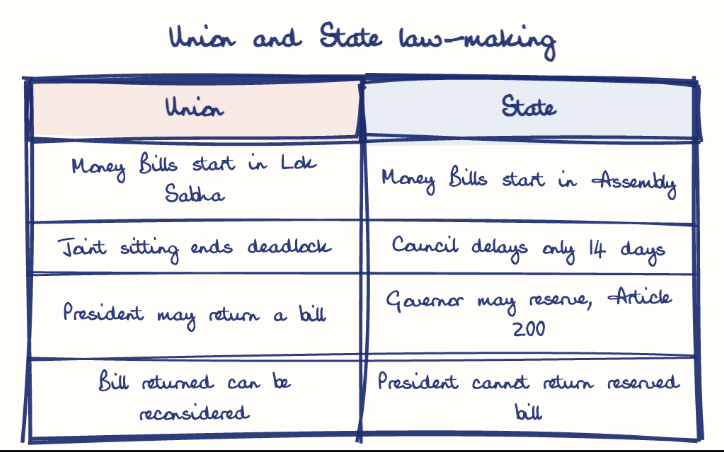
Union bills can be introduced in either House; Money Bills must originate in Lok Sabha. Parliamentary committees scrutinize bills, and joint sessions resolve bicameral deadlocks, emphasizing Lok Sabha’s primacy and ensuring thorough legislative vetting.
Presidential Assent and Oversight
The President can approve, withhold, or return bills (except Money Bills), ensuring executive oversight and constitutional compliance before enactment.
Governor’s Reservation and Presidential Assent
The Governor may reserve bills for the President under Article 200, especially those affecting High Court powers, financial matters, or imposing taxes, allowing Union intervention to prevent laws conflicting with national interests.
Legislative Council’s Limited Role and Assembly Dominance
The Council can delay Money Bills only 14 days, reinforcing Assembly dominance in financial legislation, mirroring the Lok Sabha’s role at the Union level.
Article 254 and Conflict Resolution
Union law prevails over conflicting state laws on concurrent subjects, preserving national coherence and preventing legislative repugnancy, as emphasized by the Sarkaria Commission.
Emergency Provisions and Parliamentary Supremacy
Articles 352 and 356 empower Parliament to legislate on state subjects during emergencies or President’s Rule, ensuring Union control, with laws made during President's Rule continuing until the State legislature alters them.
This model answer is indicative and the model can make mistakes; please verify key facts independently.
Practise this question
1Get the answer sheet
Sized for this question.
2Write your answer
Timed, by hand.
3Get it marked
Your score and what to fix.
This chapter in the exam
Federal structure, Governor and distribution of powers17 questions
Asked in 8 of 8 sittings since 2008
Most tested: Centre–State balance and the extent of Union supremacy over States
- 2025Although States have their separate list for law-making, this authority is not beyond the overarching legislative powers of the Parliament. Examine.
- 2023Explain the genesis of the Inter-State Council and discuss its relevance in the context of Centre-State and Inter-State coordination and cooperation in India.
All 17 questions, sorted by sub-topic, with model answers and practice.
Question from the official APPSC Group-I Mains 2025 paper. Answer written by Ghissu's engine and checked against our editorial standards. Found an error? Tell us and we correct it within 48 hours.