Panchayati Raj is a "God that failed." — Evaluate.
In short
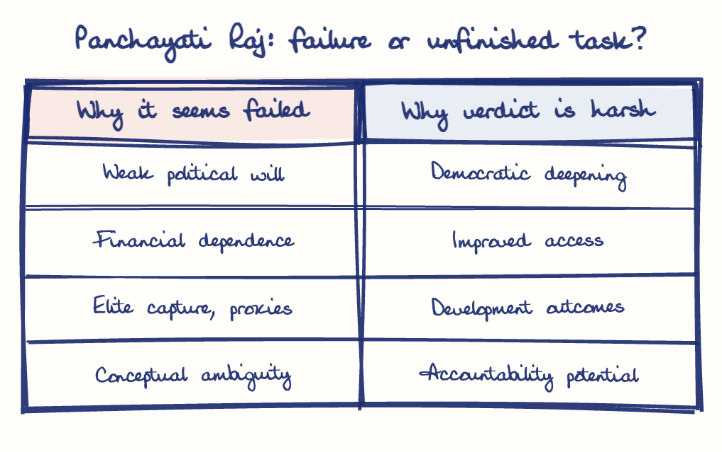
Panchayati Raj is better seen as an unfinished promise than a "God that failed": its shortfalls stem from withheld powers, funds and functionaries, elite capture and proxy representation, not from decentralisation itself. Under the 73rd Amendment, it has politically awakened villages and brought women and marginalised groups into office.
Model answer
Ghissu Editorial · Verified 4 Oct 2026 · 248 words
Three-tier Structure and Reservations
The 73rd Amendment established Panchayats at village, intermediate, and district levels with reservations for SC/ST and women, and constitutionally mandated Gram Sabhas. Schemes like Rashtriya Gram Swaraj Abhiyan32 and SVAMITVA enhance capacity and property rights.
Judicial and Policy Support
The Supreme Court’s directive against proxy participation and the 2023 Advisory Committee on Women’s Representation reflect efforts to strengthen inclusivity and transparency.
Political Will and Fiscal Dependence
State governments often delay elections and fund transfers, limiting Panchayats to implementing agencies; financial dependence on grants restricts fiscal autonomy, as noted by the Standing Committee on Rural Development (2023).
Elite Capture and Proxy Participation
Despite reservations, proxy participation persists, undermining genuine empowerment, a problem evident in Andhra Pradesh.
Democratic Engagement and Access
Panchayats have increased political awareness and improved villagers’ access to officials, fostering local leadership.
Mixed Developmental Outcomes
Schemes like MGNREGA and Swachh Bharat Mission have decentralized planning, but Andhra Pradesh CAG audits reveal gaps in welfare, education, nutrition, and public health services.
This model answer is indicative and the model can make mistakes; please verify key facts independently.
Practise this question
1Get the answer sheet
Sized for this question.
2Write your answer
Timed, by hand.
3Get it marked
Your score and what to fix.
This chapter in the exam
Local governance (73rd/74th) and Constitutional Authorities13 questions
Asked in 6 of 8 sittings since 2008
Most tested: 73rd Amendment and the Finance Commission’s role in local body devolution/fiscal federalism
- 2025Discuss the significance of the 73rd Constitutional Amendment Act in strengthening grassroots democracy in India.
- 2025The Finance Commission is considered the backbone of fiscal federalism in India. Examine its role and significance in maintaining the financial balance between the Union and the States.
All 13 questions, sorted by sub-topic, with model answers and practice.
Question from the official APPSC Group-I Mains 2008 paper. Answer written by Ghissu's engine and checked against our editorial standards. Found an error? Tell us and we correct it within 48 hours.