Explain the impact of economic reforms in the Banking sector.
In short
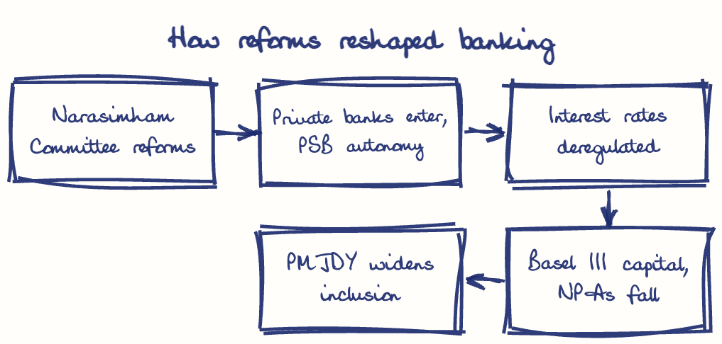
Since 1991, Narasimham Committee reforms admitted private banks, deregulated interest rates and freed public sector banks, making banking competitive and technology-led. Basel III norms raised capital adequacy and cut gross NPAs, while PMJDY widened inclusion, helping banks absorb the COVID-19 shock without a systemic crisis.
Model answer
Ghissu Editorial · Verified 4 Oct 2026 · 264 words
Liberalization of Banking Ownership
Narasimham Committee recommendations enabled private and foreign banks like ICICI and HDFC to enter, increasing competition and innovation.
Interest Rate Deregulation
Deregulation from BPLR to base rate system enhanced transparency and competitive pricing, improving resource allocation.
Strengthening Cooperative Banks
RBI’s recent reforms professionalize Urban Co2-operative Banks, crucial for rural and semi-urban credit in Andhra Pradesh, supporting agriculture and small enterprises.
Technological Modernization
Committee on Computerisation in Banks3 accelerated digital banking, improving efficiency and inclusion through automation and online services.
Improved Capital Adequacy and Asset Quality
Basel III norms and RBI oversight raised CRAR and reduced GNPA from 11.2%4 to 2.3%, strengthening financial stability.
Financial Inclusion
PMJDY5 expanded banking access, especially in Andhra Pradesh, promoting savings and credit among marginalized groups.
Enhanced Governance and Risk Management
The Indradhanush framework improved managerial accountability and reduced political interference in PSBs, boosting performance.
Inclusive Development
Credit availability boosted employment in Rayalaseema and coastal Andhra, aiding rural and semi-urban economies.
Improved Fiscal Health
Stronger banks reduced government recapitalization needs and enhanced investor confidence, facilitating capital market growth.
This model answer is indicative and the model can make mistakes; please verify key facts independently.
Practise this question
1Get the answer sheet
Sized for this question.
2Write your answer
Timed, by hand.
3Get it marked
Your score and what to fix.
This chapter in the exam
Resource Mobilization in Indian Economy19 questions
Asked in 7 of 8 sittings since 2008
Most tested: Public debt and its sustainability in post-reform India.
- 2025Differentiate between internal and external public debt. Explain their relative advantages and risks for a developing country like India.
- 2025Discuss the key instruments of Monetary Policy (RBI) and Fiscal Policy in India and evaluate their role in resource mobilisation and inflation management.
All 19 questions, sorted by sub-topic, with model answers and practice.
Question from the official APPSC Group-I Mains 2008 paper. Answer written by Ghissu's engine and checked against our editorial standards. Found an error? Tell us and we correct it within 48 hours.