Explain the methods of measuring poverty in India.
In short
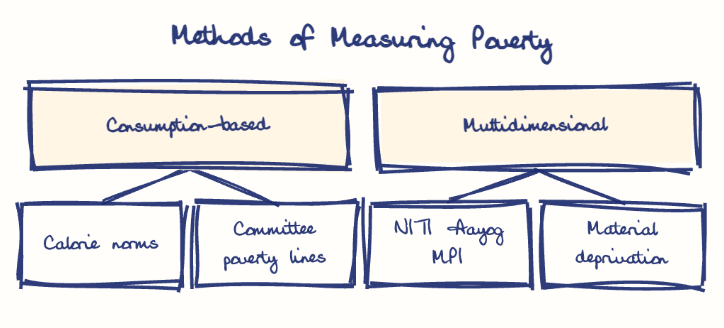
Poverty in India is measured through consumption-based poverty lines drawn by expert committees using NSSO household surveys, supplemented by NITI Aayog's Multidimensional Poverty Index covering health, education and living standards. The Lakdawala (1993), Tendulkar (2009) and Rangarajan (2014) committees successively moved the poverty line beyond calorie norms.
Model answer
Ghissu Editorial · Verified 4 Oct 2026 · 278 words
Expert Committees and Methodologies
Lakdawala (1993), Tendulkar (2009), and Rangarajan (2014) committees refined poverty lines by incorporating regional price variations, nutritional outcomes, and non-food essentials to better reflect living costs.
Multidimensional Poverty2 Index Adoption
NITI Aayog’s MPI includes health, education, and living standards, reflecting a holistic poverty view beyond income or consumption alone.
Data and Regional Disparities
NSSO surveys face comparability issues due to differing recall periods and price deflators; urban poverty in Andhra Pradesh sometimes exceeds rural, revealing gaps in measurement and policy reach.
Welfare Scheme Impact and Lapses
Schemes like MGNREGA and PM Ujjwala Yojana reduce poverty nationally, but Andhra Pradesh faces welfare fund diversion and scheme3 lapses as highlighted by CAG audits, limiting effectiveness.
Composite Indices and State Customization
Combining consumption data with multidimensional indicators and tailoring poverty lines to states like Andhra Pradesh improves accuracy and policy responsiveness.
Technology and Data Integration
Leveraging digital public infrastructure and data convergence can enhance real-time poverty monitoring and adaptive interventions.
New Expert Committee and Survey Improvements
Constitute a committee to revise poverty lines reflecting current consumption patterns, inflation, and regional disparities; standardize NSSO survey recall periods and sampling for better comparability.
Strengthen Welfare Implementation
Address administrative lapses and fund diversion issues in Andhra Pradesh to maximize poverty alleviation program impact.
This model answer is indicative and the model can make mistakes; please verify key facts independently.
Practise this question
1Get the answer sheet
Sized for this question.
2Write your answer
Timed, by hand.
3Get it marked
Your score and what to fix.
This chapter in the exam
Inclusive Growth: India and AP schemes49 questions
Asked in 8 of 8 sittings since 2008
Most tested: Women empowerment and poverty reduction through AP welfare and credit-linked institutions
- 2025Elaborate on the meaning of Inclusive Growth in the context of the Indian economy. Discuss the key strategies and instruments that can be employed to foster greater inclusion and ensure that the benefits of economic growth reach all sections of society.
- 2025Critically Examine the major poverty alleviation and employment generation programmes in India. How effective have they been in addressing rural and urban poverty?
All 49 questions, sorted by sub-topic, with model answers and practice.
Question from the official APPSC Group-I Mains 2008 paper. Answer written by Ghissu's engine and checked against our editorial standards. Found an error? Tell us and we correct it within 48 hours.