Explain the objectives of monetary policy.
In short
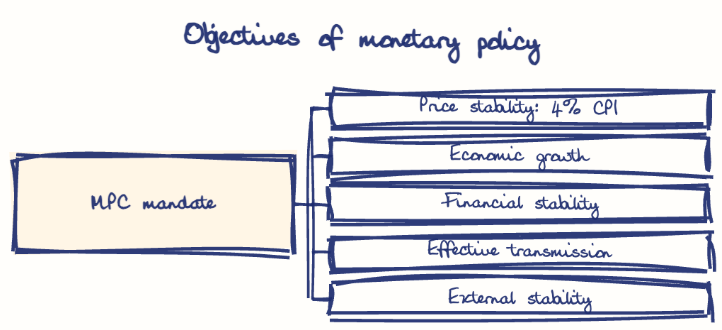
Monetary policy aims mainly at price stability, through flexible inflation targeting of 4% CPI inflation within a band of plus or minus 2%, while supporting growth. It also seeks financial stability, effective transmission and orderly exchange rates, with the Monetary Policy Committee setting the repo rate.
Model answer
Ghissu Editorial · Verified 4 Oct 2026 · 279 words
Monetary Policy Committee (MPC) Role
The MPC formulates policy with a dual mandate2 of price stability and growth, enhancing transparency and accountability since its establishment in 2016.
Inflation Targeting Regime3
Adopted in 2015 and institutionalized by the 2016 RBI Act amendment, the flexible inflation targeting framework sets a 4% CPI target within a 2% band, anchoring inflation expectations and guiding policy decisions.
Rising Inflation and RBI Policy Choices4
Inflation volatility pressures the RBI to cautiously adjust rates, balancing price stability with growth needs to protect purchasing power and economic welfare.
Editorial View5: Inflation Strengthens Case for Rate Hikes
Analysts emphasize that persistent inflation justifies monetary tightening to safeguard economic welfare and maintain financial stability, reflecting lessons from the post-2008 global financial crisis.
RBI’s Dual Mandate
Balancing inflation and growth supports political stability and democratic processes by fostering economic confidence and social cohesion.
Enhance Transmission and Inclusive Growth
Strengthening financial markets and banking infrastructure in Andhra Pradesh, especially in sectors like aquaculture and horticulture, can improve policy effectiveness and ensure benefits reach marginalized populations.
This model answer is indicative and the model can make mistakes; please verify key facts independently.
Practise this question
1Get the answer sheet
Sized for this question.
2Write your answer
Timed, by hand.
3Get it marked
Your score and what to fix.
This chapter in the exam
Resource Mobilization in Indian Economy19 questions
Asked in 7 of 8 sittings since 2008
Most tested: Public debt and its sustainability in post-reform India.
- 2025Differentiate between internal and external public debt. Explain their relative advantages and risks for a developing country like India.
- 2025Discuss the key instruments of Monetary Policy (RBI) and Fiscal Policy in India and evaluate their role in resource mobilisation and inflation management.
All 19 questions, sorted by sub-topic, with model answers and practice.
Question from the official APPSC Group-I Mains 2008 paper. Answer written by Ghissu's engine and checked against our editorial standards. Found an error? Tell us and we correct it within 48 hours.