Explain the pattern of revenue collection after economic reforms in India.
In short
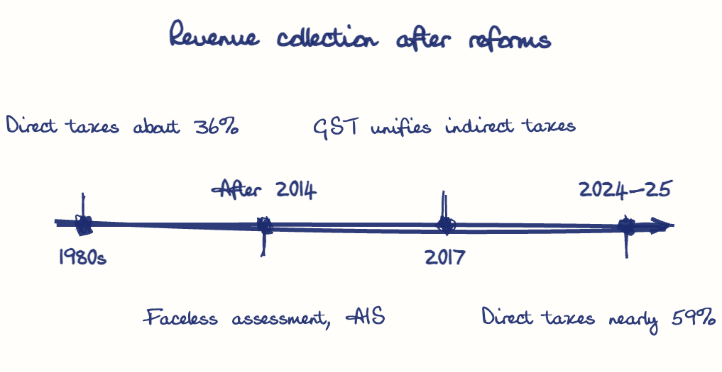
After the 1991 reforms, direct taxes rose from about 36% of gross tax revenue in the 1980s to nearly 59% by 2024-25, and GST (2017) unified indirect taxes. States like Andhra Pradesh still lag in own revenue, with a CAG audit finding a ₹1,806 crore impact in 2021-22.
Model answer
Ghissu Editorial · Verified 4 Oct 2026 · 248 words
Direct Taxes Growth
Direct taxes increased from 36% in the 1980s to 59% by 2024-25, driven by personal income tax overtaking corporate tax as the major revenue source, reflecting better compliance and formalisation.
GST’s Role
GST unified multiple indirect taxes into a single destination-based tax, boosting average monthly collections from ₹0.90 lakh crore (FY18) to ₹1.49 lakh crore (FY23), facilitating interstate commerce and reducing compliance costs.
Digital and Institutional Reforms
Post-2014 digitalisation, including the Faceless Assessment Scheme5 and Annual Information Statement, enhanced transparency and compliance; the number of income tax returns filed has risen steadily.
State-Level Fiscal Issues
Andhra Pradesh audits revealed ₹1,806 crore revenue impact (2021-22), ₹2,772 crore outstanding audit observations (2023), and ₹968 crore excess payments in CFMS audit, showing persistent revenue gaps and challenges in tax administration.
Need for Better Administration
Audit findings in Andhra Pradesh highlight the urgent need for stronger tax administration, accountability, and addressing underassessment to improve fiscal outcomes and sustainability.
This model answer is indicative and the model can make mistakes; please verify key facts independently.
Practise this question
1Get the answer sheet
Sized for this question.
2Write your answer
Timed, by hand.
3Get it marked
Your score and what to fix.
This chapter in the exam
Resource Mobilization in Indian Economy19 questions
Asked in 7 of 8 sittings since 2008
Most tested: Public debt and its sustainability in post-reform India.
- 2025Differentiate between internal and external public debt. Explain their relative advantages and risks for a developing country like India.
- 2025Discuss the key instruments of Monetary Policy (RBI) and Fiscal Policy in India and evaluate their role in resource mobilisation and inflation management.
All 19 questions, sorted by sub-topic, with model answers and practice.
Question from the official APPSC Group-I Mains 2008 paper. Answer written by Ghissu's engine and checked against our editorial standards. Found an error? Tell us and we correct it within 48 hours.