As an individual what is your role in the prevention of environmental pollution ? Explain.
In short
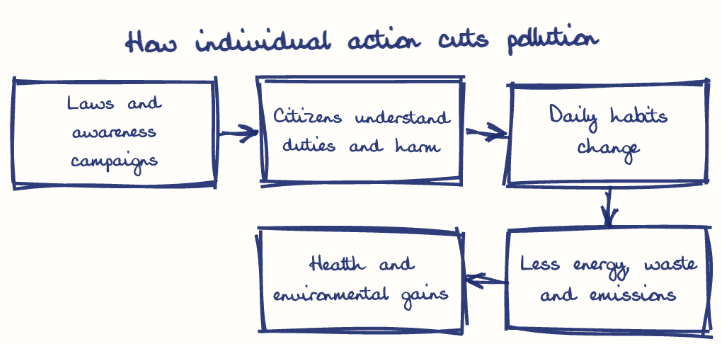
As an individual, I can prevent pollution by saving electricity, walking, cycling or using public transport, segregating and recycling waste, conserving water and joining tree planting and clean-up drives. This is also a fundamental duty under Article 51A(g) of the Constitution, which obliges every citizen to protect the natural environment.
Model answer
Ghissu Editorial · Verified 4 Oct 2026 · 248 words
Legal Duty and Environmental Laws
The Constitution mandates citizens to protect the environment; laws like the Water (Prevention and Control of Pollution) Act, 1974, and Air Act, 1981 empower State Pollution Control Boards in Andhra Pradesh, where individuals support by complying and reporting violations.
Local Governance and Waste Management
Urban Local Bodies in Andhra Pradesh manage solid waste, but 2022 audits reveal implementation gaps that citizen vigilance can address.
Vehicular Emissions1 as Pollution Driver
Vehicular emissions significantly contribute to urban pollution in cities like Vijayawada and Visakhapatnam; adopting sustainable transport reduces this impact.
Waste Segregation and Conservation Efforts
Despite claims, actual waste segregation compliance is low; individuals must actively segregate waste and participate in conservation drives like tree planting.
Energy Conservation and Pollution Reduction
Minimizing electricity use reduces emissions from power plants, yielding tangible health benefits2.
Urban Pollution Protests3 and Awareness
Societal responses, including protests, highlight public demand for cleaner environments, reinforcing individual and collective roles.
This model answer is indicative and the model can make mistakes; please verify key facts independently.
Practise this question
1Get the answer sheet
Sized for this question.
2Write your answer
Timed, by hand.
3Get it marked
Your score and what to fix.
This chapter in the exam
Development vs Environment: natural resources, climate change, EIA, natural disasters48 questions
Asked in 8 of 8 sittings since 2008
Most tested: Climate change and mining/environmental degradation links
- 2025Explain the different types of natural resources in India. How are they being conserved through government initiatives?
- 2025Investigate the relationship between mining activities and the occurrence of earthquakes. Explain how mining operations can be regulated to minimize seismic risks.
All 48 questions, sorted by sub-topic, with model answers and practice.
Question from the official APPSC Group-I Mains 2008 paper. Answer written by Ghissu's engine and checked against our editorial standards. Found an error? Tell us and we correct it within 48 hours.