Explain the different types of natural resources in India. How are they being conserved through government initiatives?
In short
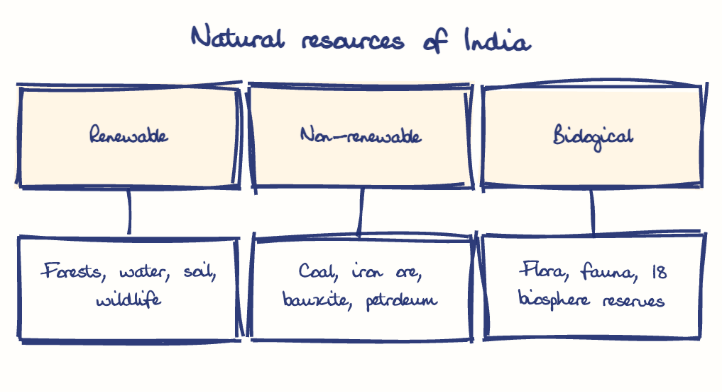
India's natural resources are renewable (forests, water, soil, wildlife), non-renewable (minerals and fossil fuels) and biological (biodiversity and protected areas). The government conserves them through the Forest Policy's one-third forest cover goal, Jal Shakti Abhiyan, Atal Bhujal Yojana, the MMDR Act and the Forest Rights Act.
Model answer
Ghissu Editorial · Verified 4 Oct 2026 · 276 words
Renewable Resources
Forests cover 24% of India; the Green India Mission21 under the National Action Plan on Climate Change (NAPCC) promotes afforestation and ecosystem restoration. Andhra Pradesh43’s Joint Forest5 Management and social forestry programs enhance local involvement in forest conservation.
Non-Renewable Resources
India’s mineral wealth includes coal, iron ore, and barytes, with Andhra Pradesh holding 86.11% of India’s barytes reserves. The Mines and Minerals Act regulates extraction, but CAG audits highlight revenue and compliance gaps in Andhra Pradesh’s mining sector.
Community Participation and Legal Frameworks
The Forest Rights Act empowers indigenous communities; Andhra Pradesh’s local panchayats actively manage resources, reflecting decentralization. Constitutional provisions under Articles 48-A and 51-A(g) mandate environmental protection.
Strengthen Capacity and Monitoring
Enhance community capacity building and use satellite remote sensing for real-time monitoring to ensure compliance.
Integrate Resource Efficiency
Promote sustainable technologies in agriculture and urban planning to reduce resource depletion.
This model answer is indicative and the model can make mistakes; please verify key facts independently.
Practise this question
1Get the answer sheet
Sized for this question.
2Write your answer
Timed, by hand.
3Get it marked
Your score and what to fix.
This chapter in the exam
Development vs Environment: natural resources, climate change, EIA, natural disasters48 questions
Asked in 8 of 8 sittings since 2008
Most tested: Climate change and mining/environmental degradation links
- 2025Investigate the relationship between mining activities and the occurrence of earthquakes. Explain how mining operations can be regulated to minimize seismic risks.
- 2025Define sustainable development and critically evaluate its relevance in the context of modern industrialization.
All 48 questions, sorted by sub-topic, with model answers and practice.
Question from the official APPSC Group-I Mains 2025 paper. Answer written by Ghissu's engine and checked against our editorial standards. Found an error? Tell us and we correct it within 48 hours.