Investigate the relationship between mining activities and the occurrence of earthquakes. Explain how mining operations can be regulated to minimize seismic risks.
In short
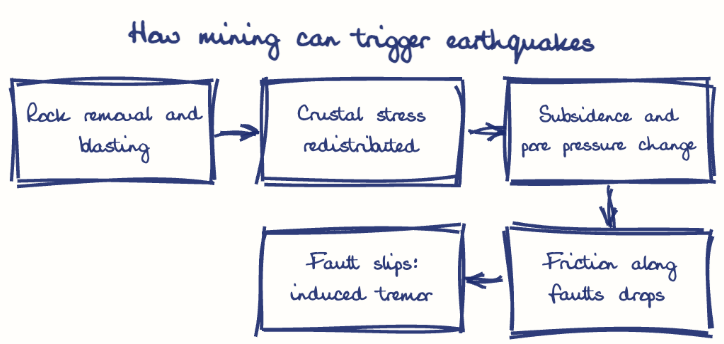
Mining can induce earthquakes by redistributing crustal stress, blasting, subsidence that reactivates faults, and groundwater changes that alter pore pressure, much like the reservoir-triggered 1967 Koyna quake. It can be regulated through cluster-based impact assessment under the EIA Amendment 2016, lease limits, seismic monitoring and curbs on illegal mining.
Model answer
Ghissu Editorial · Verified 4 Oct 2026 · 239 words
Anthropogenic Seismicity Evidence
Deep underground mining and blasting correlate with increased seismic events, as seen in coal and mineral mining regions.
Regional Mining Clusters
Simultaneous mining leases cumulatively alter subsurface stress; Andhra Pradesh’s Rayalaseema belt exemplifies localized seismic disturbances requiring state-specific regulation.
Stress Redistribution
Extraction causes stress shifts in the crust, triggering fault slippage and earthquakes.
Water Table Alterations
Mining-induced groundwater changes reduce fault friction, facilitating seismic activity.
Cluster-Based EIAs
The 2016 EIA Amendment mandates cumulative impact assessments for mining clusters to cap leases and reduce seismic hazards.
Licensing and Monitoring
The Mines and Minerals Act limits lease size; Andhra Pradesh’s Directorate of Mines and Geology enforces these to regulate mining intensity.
Technological Collaboration
MoU between India’s DGMS and Queensland’s SIMTARS promotes risk-based safety management adaptable to Andhra Pradesh.
Enhanced Seismic Monitoring
Establish seismic observatories in mining zones of Andhra Pradesh for real-time tremor detection.
Integrated Planning
Cluster-based lease approvals with community input balance economic and seismic safety.
Legal Enforcement
Single-window approvals and strict penalties curb illegal mining and unregulated seismic risks.
This model answer is indicative and the model can make mistakes; please verify key facts independently.
Sources
Practise this question
1Get the answer sheet
Sized for this question.
2Write your answer
Timed, by hand.
3Get it marked
Your score and what to fix.
This chapter in the exam
Development vs Environment: natural resources, climate change, EIA, natural disasters48 questions
Asked in 8 of 8 sittings since 2008
Most tested: Climate change and mining/environmental degradation links
- 2025Explain the different types of natural resources in India. How are they being conserved through government initiatives?
- 2025Define sustainable development and critically evaluate its relevance in the context of modern industrialization.
All 48 questions, sorted by sub-topic, with model answers and practice.
Question from the official APPSC Group-I Mains 2025 paper. Answer written by Ghissu's engine and checked against our editorial standards. Found an error? Tell us and we correct it within 48 hours.