Explain about the mineral resources present in India.
In short
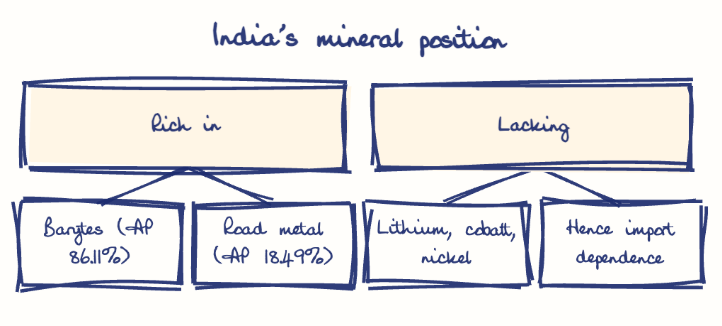
India has rich but unevenly spread mineral resources, with metallic minerals concentrated in the peninsular plateau and eastern belts, while critical minerals like lithium, cobalt and nickel are scarce and imported. The 2023 MMDR amendment placed 24 critical minerals under central auction, and Andhra Pradesh holds 86.11% of India's barytes.
Model answer
Ghissu Editorial · Verified 4 Oct 2026 · 271 words
Exploration Agencies
The Geological Survey of India, MECL, and NMDC conduct systematic surveys, providing critical data for mineral development and aiding discovery of new deposits.
Regulatory Updates
The Mines and Minerals (Development and Regulation) Act, amended in 2023, lists 24 critical and strategic minerals in Part D of the First Schedule, facilitating focused exploration and mining of rare earths and energy metals. This legal framework aims to streamline licensing and promote transparency.
State-Level Issues
Andhra Pradesh1 controls significant mineral reserves but struggles with revenue collection and compliance, as audit reports highlight gaps in remittances to the mineral exploration trust fund. Additionally, challenges in regulatory enforcement and illegal mining affect sustainable resource management.
Sustainable Mining and Infrastructure
Emphasizing free, prior, and informed consent in sensitive areas and investing in infrastructure and skill development will improve sector efficiency. Aligning vocational training with industry needs and upgrading transport networks are key to boosting productivity.
This model answer is indicative and the model can make mistakes; please verify key facts independently.
Practise this question
1Get the answer sheet
Sized for this question.
2Write your answer
Timed, by hand.
3Get it marked
Your score and what to fix.
This chapter in the exam
Development vs Environment: natural resources, climate change, EIA, natural disasters48 questions
Asked in 8 of 8 sittings since 2008
Most tested: Climate change and mining/environmental degradation links
- 2025Explain the different types of natural resources in India. How are they being conserved through government initiatives?
- 2025Investigate the relationship between mining activities and the occurrence of earthquakes. Explain how mining operations can be regulated to minimize seismic risks.
All 48 questions, sorted by sub-topic, with model answers and practice.
Question from the official APPSC Group-I Mains 2008 paper. Answer written by Ghissu's engine and checked against our editorial standards. Found an error? Tell us and we correct it within 48 hours.