(i) Explain about the types of forests present in India. (ii) How are forests helping the human society ? Explain.
In short
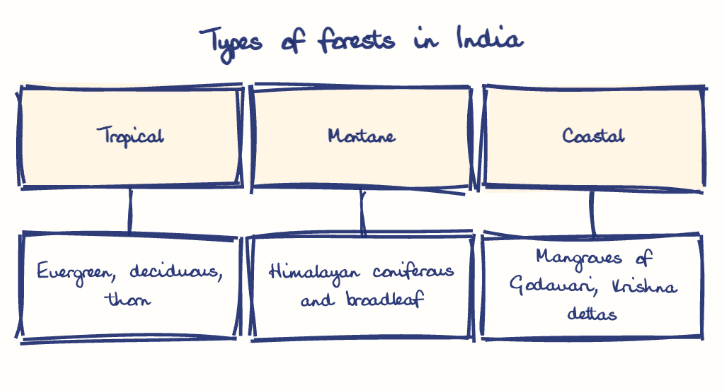
India's forests are tropical evergreen, tropical deciduous (the most widespread), tropical thorn, montane and mangrove types, together with tree cover spanning about 25.17% of the country per ISFR 2023. They help society by regulating climate and soil, supporting livelihoods through fuel, fodder and timber, conserving biodiversity and absorbing carbon.
Model answer
Ghissu Editorial · Verified 4 Oct 2026 · 285 words
Tropical Evergreen and Deciduous Forests
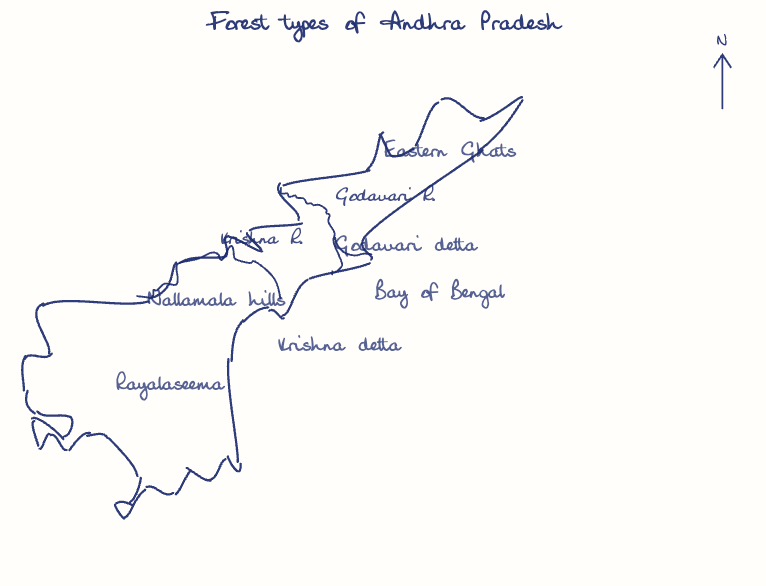
Found in the Western Ghats, northeast, and Eastern Ghats in Andhra Pradesh, these forests support rich biodiversity and provide timber and non-timber products. Deciduous forests shed leaves seasonally, aiding nutrient cycling.
Mangrove Forests
Coastal mangroves in Godavari and Krishna deltas protect shorelines, support fisheries, and act as carbon sinks under initiatives like MISHTI. They also buffer against cyclones, reducing disaster impacts.
Ecological Services and Livelihoods
Forests regulate climate and prevent erosion (e.g., Eastern Ghats), while schemes like MGNREGS in Andhra Pradesh integrate conservation with rural employment. Forests also provide fuelwood, fodder, and medicinal plants essential for rural communities.
Agroforestry and Community Participation
Expanding the National Agroforestry Policy and empowering local communities in Andhra Pradesh can reduce forest pressure and improve conservation. Capacity building and decentralized management are key.
Mangrove Conservation and Rural Development
Scaling MISHTI and linking forest conservation with MGNREGS in Rayalaseema will enhance resilience and livelihoods. Integrating watershed management will further support drought-prone areas.
This model answer is indicative and the model can make mistakes; please verify key facts independently.
Practise this question
1Get the answer sheet
Sized for this question.
2Write your answer
Timed, by hand.
3Get it marked
Your score and what to fix.
This chapter in the exam
Development vs Environment: natural resources, climate change, EIA, natural disasters48 questions
Asked in 8 of 8 sittings since 2008
Most tested: Climate change and mining/environmental degradation links
- 2025Explain the different types of natural resources in India. How are they being conserved through government initiatives?
- 2025Investigate the relationship between mining activities and the occurrence of earthquakes. Explain how mining operations can be regulated to minimize seismic risks.
All 48 questions, sorted by sub-topic, with model answers and practice.
Question from the official APPSC Group-I Mains 2008 paper. Answer written by Ghissu's engine and checked against our editorial standards. Found an error? Tell us and we correct it within 48 hours.