(i) What are the threats to Indian biodiversity ? (ii) How can Indian biodiversity be conserved ?
In short
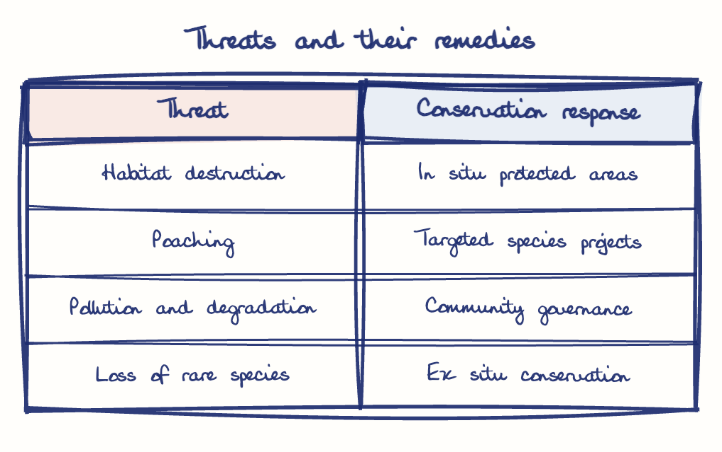
Indian biodiversity, about 7-8% of recorded species, is threatened by habitat destruction, poaching and wildlife trade, pollution, climate change and invasive species. It can be conserved through protected areas like 18 biosphere reserves, ex situ seed banks and zoos, community Biodiversity Management Committees and flagship projects such as Project Tiger.
Model answer
Ghissu Editorial · Verified 4 Oct 2026 · 275 words
Habitat Destruction and Fragmentation
Expansion of agriculture, mining, and urbanisation fragments habitats, notably in the Western Ghats, reducing forest cover and species viability. Infrastructure projects and mining exacerbate this loss, disrupting ecosystem integrity.
Overexploitation and Poaching
Illegal trade threatens keystone species like tigers and elephants, undermining ecosystem stability. Demand for animal parts and medicinal plants fuels rampant poaching, endangering critical species.
In Situ Conservation and Protected Areas1
India’s 18 biosphere reserves, over 100 national parks and over 570 sanctuaries, including Andhra Pradesh’s Nagarjuna Sagar-Srisailam Tiger Reserve, protect ecosystems; flagship projects like Project Tiger2 and Project Snow Leopard have increased tiger populations from 2,226 (2014) to 3,682 recently. These protected areas maintain natural habitats and support species recovery.
Community Participation and Governance
The three-tier biodiversity governance3 model with 2,76,653 Biodiversity Management Committees and People’s Biodiversity Registers empowers local communities; Andhra Pradesh’s community-led sacred groves and wetlands exemplify this. Such involvement ensures sustainable resource use and local stewardship.
Way Forward
Strengthen habitat connectivity via ecological corridors, especially in Andhra Pradesh’s Eastern Ghats; promote sustainable livelihoods for forest communities through eco-tourism and sustainable harvesting; and leverage GIS and AI for real-time biodiversity monitoring and threat assessment.
This model answer is indicative and the model can make mistakes; please verify key facts independently.
Practise this question
1Get the answer sheet
Sized for this question.
2Write your answer
Timed, by hand.
3Get it marked
Your score and what to fix.
This chapter in the exam
Biotechnology & Nanotechnology: scope, ethics, genetic engineering, biodiversity, fermentation, immuno-diagnosis50 questions
Asked in 8 of 8 sittings since 2008
Most tested: Biodiversity and biotechnology governance/ethics, especially conservation, GMOs, and applied public-health biotech.
- 2025Trace the evolution of India's National Biotechnology Development Strategy (NBDS) and discuss its key objectives. Critically evaluate its impact on the growth of the biotechnology sector in India.
- 2025Analyze the potential of plant-derived biopharmaceuticals in promoting sustainable healthcare. Explain how the application of green pharmacy principles can help minimize environmental harm at each stage of the pharmaceutical lifecycle.
All 50 questions, sorted by sub-topic, with model answers and practice.
Question from the official APPSC Group-I Mains 2008 paper. Answer written by Ghissu's engine and checked against our editorial standards. Found an error? Tell us and we correct it within 48 hours.