Account for the rise and growth of peasant and working class movements and their contribution in anti-feudal and anti-colonial struggles.
In short
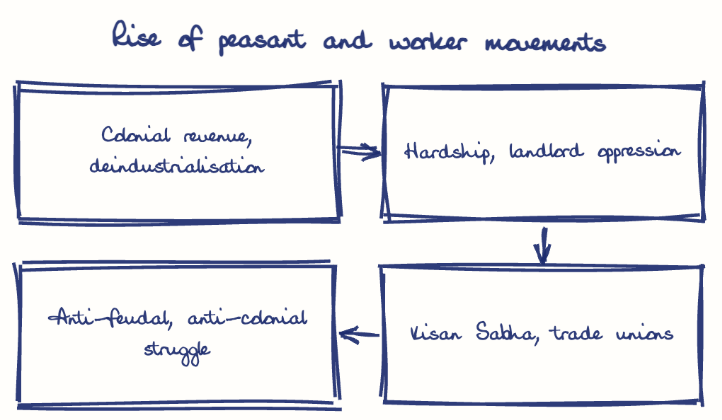
Peasant and working class movements grew from colonial revenue exploitation, the collapse of traditional livelihoods and feudal oppression, and fought feudal and colonial power together through Kisan Sabhas, trade unions and mass protests. In Telangana and coastal Andhra, the Telangana struggle and zamindari abolition reshaped landholding.
Model answer
Ghissu Editorial · Verified 4 Oct 2026 · 270 words
Colonial Economic and Feudal Exploitation
British land revenue systems like Zamindari and Ryotwari imposed heavy taxes, causing widespread indebtedness; landlords and moneylenders extracted high rents and forced labour, while deindustrialisation pushed artisans into landlessness.
Critique and Organisation
Jyotiba Phule’s Shetkaryacha Asud (‘Kisan Ka Koda2’, 1883) exposed the exploitation of cultivators, and later the Kisan Sabhas and trade unions such as the AITUC (1920) organised peasants and workers.
Mobilizing Marginalized Groups
Movements united landless labourers and outcastes, weakening feudal hierarchies and promoting social equity, exemplified by the 1921 Chargola exodus3 of plantation women showing intersectionality.
Political Integration and Empowerment
Peasant and worker movements linked economic struggles with nationalist politics, with Kisan Sabha and trade unions playing key roles; in Telangana, the armed struggle against the Nizam’s jagirdars combined anti-feudal and political goals.
Sustaining Mass Mobilization
These movements provided a broad base for protests and strikes, amplifying campaigns like the Champaran Satyagraha and Quit India Movement, strengthening anti-colonial resistance.
Inclusive Agrarian Reforms and Political Education
Strengthening land redistribution and rural political awareness is vital for sustaining empowerment.
This model answer is indicative and the model can make mistakes; please verify key facts independently.
Practise this question
1Get the answer sheet
Sized for this question.
2Write your answer
Timed, by hand.
3Get it marked
Your score and what to fix.
This chapter in the exam
Indian Nationalism in Three Phases; Independence, Partition and After22 questions
Asked in 8 of 8 sittings since 2008
Most tested: Gandhian mass movements and their impact, alongside peasant mobilisation and communalism/partition.
- 2025Discuss the role and contributions of the moderate leaders of Congress from 1885 to 1905.
- 2025Describe the major movements led by Mahatma Gandhi between 1920 and 1947.
All 22 questions, sorted by sub-topic, with model answers and practice.
Question from the official APPSC Group-I Mains 2011 paper. Answer written by Ghissu's engine and checked against our editorial standards. Found an error? Tell us and we correct it within 48 hours.