Compare and contrast the views of Mahatma Gandhi and Ambedkar with regard to the abolition of untouchability and Harijan upliftment.
In short
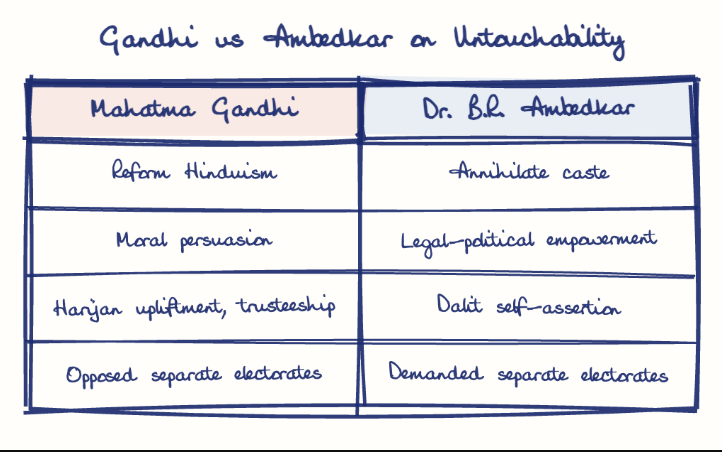
Gandhi and Ambedkar both sought to end untouchability, but Gandhi pursued a moral change of heart within Hinduism while preserving varna, whereas Ambedkar demanded the annihilation of caste through law and political rights. Their sharpest clash was over separate electorates, which Gandhi opposed and which ended in the Poona Pact.
Model answer
Ghissu Editorial · Verified 4 Oct 2026 · 332 words
Trusteeship and Mass Mobilization
He linked Harijan upliftment to nationalist struggles and promoted trusteeship, urging wealth holders to act for public welfare. Gandhi’s approach emphasized education, hygiene, and social reform among Harijans to integrate them into society.
Annihilation of Caste and Legal Empowerment
Ambedkar condemned caste as irrational, demanding its total abolition, constitutional safeguards, and separate electorates for Dalit political rights. He viewed legal and economic reforms as essential alongside education for Dalit emancipation.
Critique of Hinduism and Dalit Identity
He rejected Hindu scriptures legitimizing caste and opposed Gandhi’s “Harijan” term, advocating Dalit self-representation. Ambedkar promoted secularism and freedom of religion as alternatives to oppressive Hindu norms.
Ideological Foundations
Gandhi’s spiritual reform sought to cleanse Hinduism of untouchability while preserving varna; Ambedkar demanded a structural overhaul, calling for the annihilation of caste itself.
Methods and Politics
Gandhi relied on moral persuasion and opposed separate electorates fearing Hindu unity, culminating in the Poona Pact1; Ambedkar stressed legal activism and initially demanded separate electorates to secure Dalit political voice.
This model answer is indicative and the model can make mistakes; please verify key facts independently.
Sources
Practise this question
1Get the answer sheet
Sized for this question.
2Write your answer
Timed, by hand.
3Get it marked
Your score and what to fix.
This chapter in the exam
British Rule 1757-1856, the 1857 Revolt, Socio-Religious Reform & the Rise of Nationalism20 questions
Asked in 8 of 8 sittings since 2008
Most tested: Colonialism’s impact on Indian society/economy and reform-led social uplift, especially untouchability and caste reform.
- 2025What do you understand by the Permanent Settlement, and what impact did it have on Indian society? Comment.
- 2025What do you understand by the 'safety valve' theory? Explain it in the context of the Indian National Congress?
All 20 questions, sorted by sub-topic, with model answers and practice.
Question from the official APPSC Group-I Mains 2011 paper. Answer written by Ghissu's engine and checked against our editorial standards. Found an error? Tell us and we correct it within 48 hours.