Discuss the socio-economic and religious conditions during the period of Satavahanas in Ancient Andhra Desha.
In short
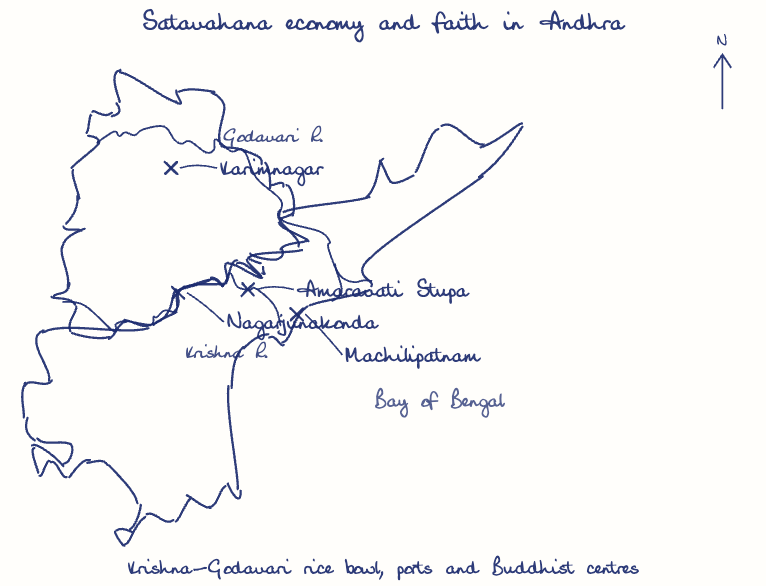
The Satavahana period in Andhra Desha saw agrarian prosperity between the Krishna and Godavari, thriving towns, merchant guilds and overseas trade, alongside a hardening caste order. Religion was plural: kings performed Vedic sacrifices yet patronised Buddhist centres at Amaravati, Bhattiprolu and Dhulikatta in Karimnagar.
Model answer
Ghissu Editorial · Verified 4 Oct 2026 · 263 words
Urban Centres and Trade Networks
Commercial hubs like Prathisthana, Amaravati, and Sopara flourished, supported by merchant guilds (srenis) and civic bodies (nigama sabhas); ports such as Machilipatnam enabled overseas trade, evidenced by ship depictions on Satavahana coins.
Crafts, Currency, and Material Culture
The Satavahanas issued lead, copper, and bronze coins, reflecting a monetized economy; iron tools and mineral exploitation in Karimnagar and Warangal boosted production and crafts.
Religious Pluralism and Patronage
Brahmanism, Buddhism, and Jainism thrived simultaneously; rulers patronized Brahmanism and Buddhist centres at Amaravati and Dhulikatta, a tradition continued at Nagarjunakonda under the Ikshvakus, granting lands to monks and supporting religious coexistence.
Royal Religious Authority and Transformation
Satavahana kings performed grand Vedic sacrifices (asvamedha, rajasuya); Gautamiputra Satakarni’s inscriptions emphasize upholding the varna system and suppressing foreign invaders; Vedic ritualism evolved towards inclusive Puranic theism, adapting to heterodox influences.
Heritage Conservation and Education
Preserve archaeological sites like Amaravati and Nagarjunakonda to sustain cultural memory; integrate Satavahana history into Andhra Pradesh1 curricula to strengthen regional identity and historical awareness.
Agrarian Lessons for Rural Development
Emulate Satavahana agrarian prosperity by promoting modern agricultural practices and rural livelihoods in Andhra Pradesh, drawing on historical land grant policies and irrigation techniques.
This model answer is indicative and the model can make mistakes; please verify key facts independently.
Practise this question
1Get the answer sheet
Sized for this question.
2Write your answer
Timed, by hand.
3Get it marked
Your score and what to fix.
This chapter in the exam
Andhra - Ancient16 questions
Asked in 8 of 8 sittings since 2008
Most tested: Satavahana socio-religious and cultural life, especially society, religion, and literature.
- 2025How did far trade routes contribute to the exchange of Buddhist ideas in ancient Andhra?
- 2025What are the various stories about the origins of Andhra people and the Andhra language?
All 16 questions, sorted by sub-topic, with model answers and practice.
Question from the official APPSC Group-I Mains 2011 paper. Answer written by Ghissu's engine and checked against our editorial standards. Found an error? Tell us and we correct it within 48 hours.