Trace the course of events leading to the Partition of India in 1947.
In short
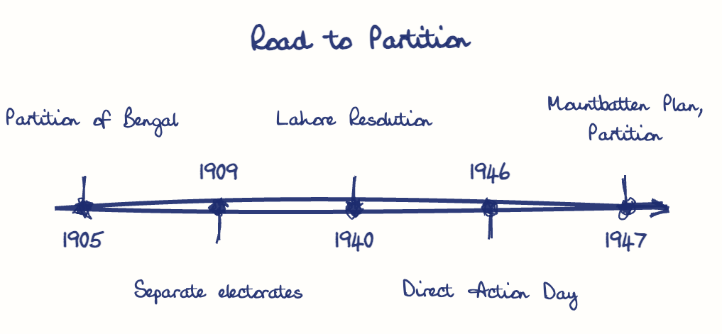
Partition resulted from separate electorates from 1909, the Muslim League's demand for Pakistan in the Lahore Resolution (1940), and the failure of the Cripps Mission, Simla Conference and Cabinet Mission Plan. Direct Action Day (1946) and riots led to the Mountbatten Plan and the Indian Independence Act of July 1947.
Model answer
Ghissu Editorial · Verified 4 Oct 2026 · 252 words
British Divide-and-Rule Policies
The Morley-Minto Reforms (1909) and Government of India Act (1935) institutionalized communal electorates, deepening divisions and fostering political segregation along religious lines.
Rise of Muslim League and Two-Nation Theory2
Founded in 1906, the League’s Lahore Resolution (1940) formalized demand for Pakistan under Jinnah’s leadership, asserting Muslims as a separate nation requiring a distinct homeland.
Failed Constitutional Negotiations
The Nehru Report, Cripps Mission (1942), and Cabinet Mission Plan (1946) failed due to irreconcilable Congress-Muslim League differences over power-sharing and representation, leading to political deadlock.
Communal Violence and Direct Action Day
The Muslim League’s 1946 call led to the Great Calcutta Killing, escalating communal tensions irreversibly and shattering hopes for peaceful coexistence.
British Expediency and Withdrawal
Post-WWII Britain, weakened economically, prioritized quick exit, passing the Indian Independence3 Act (1947), formalizing partition amid escalating violence and mass migrations.
Strengthen Constitutional Safeguards
Protect minority rights through robust legal frameworks and promote inclusive political representation to address historical grievances.
This model answer is indicative and the model can make mistakes; please verify key facts independently.
Practise this question
1Get the answer sheet
Sized for this question.
2Write your answer
Timed, by hand.
3Get it marked
Your score and what to fix.
This chapter in the exam
Indian Nationalism in Three Phases; Independence, Partition and After22 questions
Asked in 8 of 8 sittings since 2008
Most tested: Gandhian mass movements and their impact, alongside peasant mobilisation and communalism/partition.
- 2025Discuss the role and contributions of the moderate leaders of Congress from 1885 to 1905.
- 2025Describe the major movements led by Mahatma Gandhi between 1920 and 1947.
All 22 questions, sorted by sub-topic, with model answers and practice.
Question from the official APPSC Group-I Mains 2011 paper. Answer written by Ghissu's engine and checked against our editorial standards. Found an error? Tell us and we correct it within 48 hours.