Trace the evolution of Indian Nationalism with reference to the three phases of the Freedom Struggle between the years 1885-1947.
In short
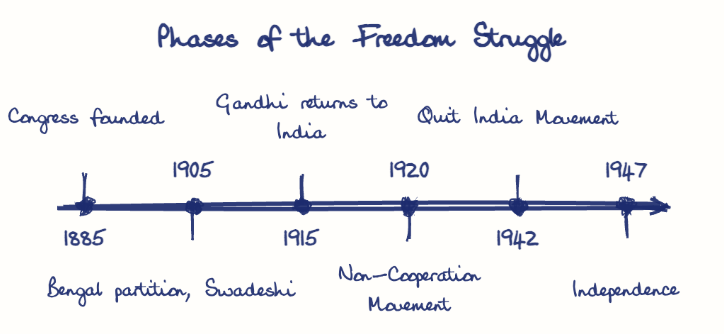
Indian nationalism evolved through three phases: moderate constitutionalism (1885-1905), extremist and Swadeshi assertion after the 1905 Partition of Bengal (1905-1919), and Gandhian mass struggle (1920-1947). Each phase widened the movement's base, from a petitioning elite to Non-Cooperation, Civil Disobedience and Quit India, ending colonial rule in 1947.
Model answer
Ghissu Editorial · Verified 4 Oct 2026 · 325 words
Moderate Phase (1885-1905)
The Indian National Congress’s formation marked nationalism’s start, with leaders like Dadabhai Naoroji focusing on economic critiques such as the Drain Theory and constitutional reforms through petitions. This phase remained largely loyalist and elitist, relying on dialogue with the British.
Extremist and Mass Phase (1905-1920)
The Partition of Bengal in 1905 triggered the Swadeshi Movement and militant nationalism under Bal Gangadhar Tilak, promoting swaraj and swadeshi, expanding nationalism to popular participation. Cultural revival and assertive political action united diverse groups, marking a shift from elite to mass nationalism.
First Phase (1885-1905)
Characterized by constitutional agitation and petitions, the Congress sought legislative reforms but lacked mass support. The British largely dismissed these demands, leading to growing frustration among Indian leaders.
Second Phase (1905-1919)
Marked by boycott campaigns and revolutionary activities, this phase also saw the Muslim League’s foundation in 1906, reflecting communal assertions. The Swadeshi Movement spread beyond Bengal, and extremist leaders challenged colonial authority more directly.
Gandhian Mass Nationalism (1920-1947)
Gandhi’s arrival in 1915 introduced satyagraha and nonviolent resistance, with movements like Non-Cooperation (1920), Civil Disobedience (1930), and Quit India (1942) mobilizing diverse groups. This phase transformed nationalism into a broad-based, inclusive struggle for complete independence.
This model answer is indicative and the model can make mistakes; please verify key facts independently.
Sources
Practise this question
1Get the answer sheet
Sized for this question.
2Write your answer
Timed, by hand.
3Get it marked
Your score and what to fix.
This chapter in the exam
Indian Nationalism in Three Phases; Independence, Partition and After22 questions
Asked in 8 of 8 sittings since 2008
Most tested: Gandhian mass movements and their impact, alongside peasant mobilisation and communalism/partition.
- 2025Discuss the role and contributions of the moderate leaders of Congress from 1885 to 1905.
- 2025Describe the major movements led by Mahatma Gandhi between 1920 and 1947.
All 22 questions, sorted by sub-topic, with model answers and practice.
Question from the official APPSC Group-I Mains 2011 paper. Answer written by Ghissu's engine and checked against our editorial standards. Found an error? Tell us and we correct it within 48 hours.