Write an essay on the growth of Buddhism in Ancient Andhra Desha and the salient features of Buddhist Art and Architecture with examples.
In short
Buddhism grew in Andhra even before Asoka, sustained by agrarian and trade prosperity, merchant patronage and its appeal to women and Sudras. Its art features monumental stupas like the Dhanyakataka (Amaravati) Stupa, the naturalistic Amaravati school of sculpture and monastic learning centres at Nagarjunakonda.
Model answer
Ghissu Editorial · Verified 4 Oct 2026 · 269 words
Social Reform and Inclusivity
Buddhism’s appeal to marginalized groups such as women and Sudras challenged Brahmanical exclusivism, promoting spiritual equality and rationalism, which helped broaden its base in Andhra society.
Stupa Architecture and Sculpture
Andhra’s Dhanyakataka Stupa and Amaravati school sculptures are noted for monumental scale and naturalistic, narrative reliefs. The Amaravati style is distinguished by dynamic, flowing figures and detailed ornamentation.
Cultural Synthesis and Education
Local tribal motifs enriched Buddhist iconography; monastic complexes like Nagarjunakonda served as learning centers. These viharas were hubs for manuscript production and intellectual exchange, preserving Buddhist teachings.
Key Sites
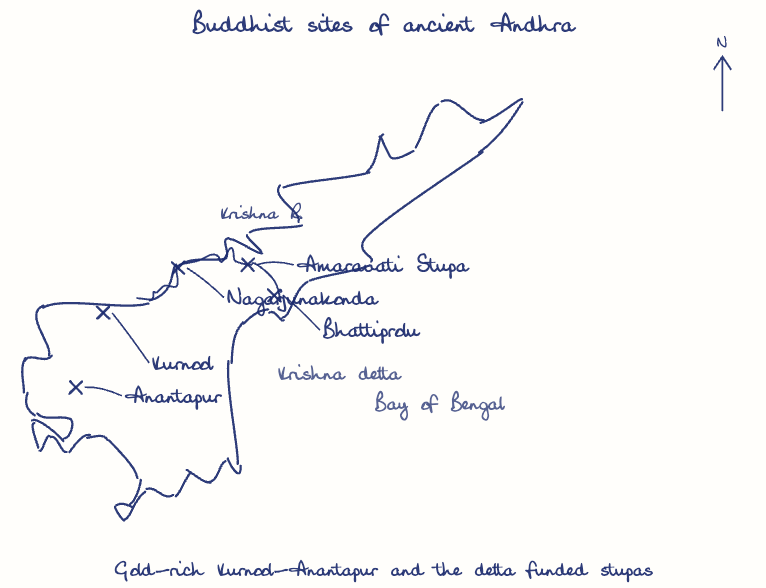
Dhanyakataka Stupa near Amaravati and Nagarjunakonda Monastic Complex highlight Andhra’s Buddhist heritage; Bhattiprolu inscriptions show linguistic integration through Prakrit and proto-Telugu usage.
International Influence
Amaravati-style Buddha images found in Southeast Asia, e.g., Vietnam’s Dong-duong, demonstrate cultural export and Andhra’s role in spreading Buddhism beyond India.
Preservation and Research
Strengthen heritage conservation through state-supported archaeological projects and tourism initiatives. Promote interdisciplinary academic studies to deepen understanding of Andhra’s Buddhist legacy and its impact on art, culture, and philosophy.
This model answer is indicative and the model can make mistakes; please verify key facts independently.
Practise this question
1Get the answer sheet
Sized for this question.
2Write your answer
Timed, by hand.
3Get it marked
Your score and what to fix.
This chapter in the exam
Andhra - Ancient16 questions
Asked in 8 of 8 sittings since 2008
Most tested: Satavahana socio-religious and cultural life, especially society, religion, and literature.
- 2025How did far trade routes contribute to the exchange of Buddhist ideas in ancient Andhra?
- 2025What are the various stories about the origins of Andhra people and the Andhra language?
All 16 questions, sorted by sub-topic, with model answers and practice.
Question from the official APPSC Group-I Mains 2011 paper. Answer written by Ghissu's engine and checked against our editorial standards. Found an error? Tell us and we correct it within 48 hours.