"The basic structure of the Constitution in effect limits the amending power of the Parliament." – Discuss.
In short
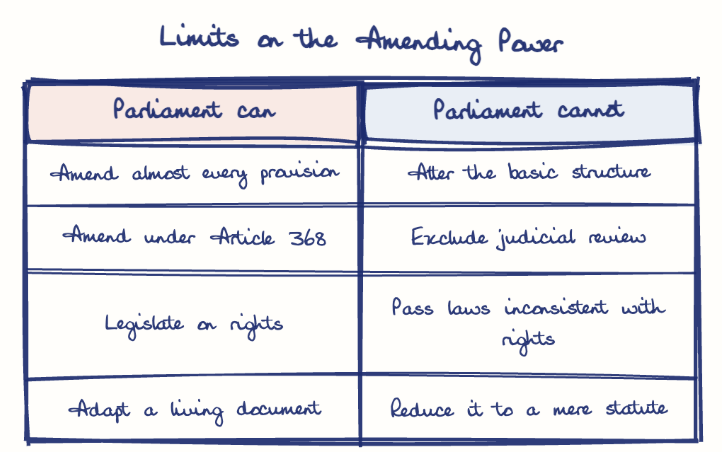
The basic structure doctrine, laid down in Kesavananda Bharati (1973), does limit Parliament's amending power under Article 368, since amendments cannot destroy core features like judicial review, federalism and secularism. Minerva Mills (1980) used it to strike down provisions excluding judicial review, though critics warn of judicial overreach.
Model answer
Ghissu Editorial · Verified 4 Oct 2026 · 284 words
Judicial Innovation
Kesavananda Bharati introduced the doctrine, preventing Parliament from altering the Constitution’s essential features like secularism, federalism, and judicial review.
Core Elements
The Court identified key components such as supremacy of the Constitution, separation of powers, and parliamentary system without exhaustive definition.
Balancing Change and Continuity
The doctrine allows constitutional evolution while preserving foundational identity, ensuring amendments do not erode democratic governance or constitutional morality.
Judicial Review
The Supreme Court invalidated amendments excluding judicial review in Minerva Mills (1980), affirming it as a basic structure element.
Fundamental Rights Protection
I.R. Coelho v. State of Tamil Nadu (2007) reinforced that fundamental rights cannot be arbitrarily amended or abrogated.
Restriction on Parliamentary Sovereignty
The doctrine curtails absolute sovereignty by preventing Parliament from reducing the Constitution to a mere statute.
Contemporary Issues
The 130th Amendment Bill, 2025, is criticized for threatening federalism and separation of powers, showing the doctrine’s role in checking parliamentary sovereignty.
Preserving Constitutional Identity
The doctrine maintains governance stability and minority rights against majoritarianism.
State Safeguards
Andhra Pradesh benefits from the doctrine protecting federalism and state autonomy post-bifurcation.
Judicial-Parliamentary Balance
It fosters constitutionalism by balancing Parliament’s mandate with judicial protection of core principles.
This model answer is indicative and the model can make mistakes; please verify key facts independently.
Practise this question
1Get the answer sheet
Sized for this question.
2Write your answer
Timed, by hand.
3Get it marked
Your score and what to fix.
This chapter in the exam
Judiciary in India15 questions
Asked in 8 of 8 sittings since 2008
Most tested: Judicial review and its scope/limits
- 2025What are the emergency functions of the Union Government of India? Describe how they impact the legislative powers of Parliament and State Legislatures.
- 2025Discuss any two constitutional amendments that have significantly affected the powers or functioning of the Indian judiciary.
All 15 questions, sorted by sub-topic, with model answers and practice.
Question from the official APPSC Group-I Mains 2011 paper. Answer written by Ghissu's engine and checked against our editorial standards. Found an error? Tell us and we correct it within 48 hours.