Critically Examine the role of RBI in credit control.
In short
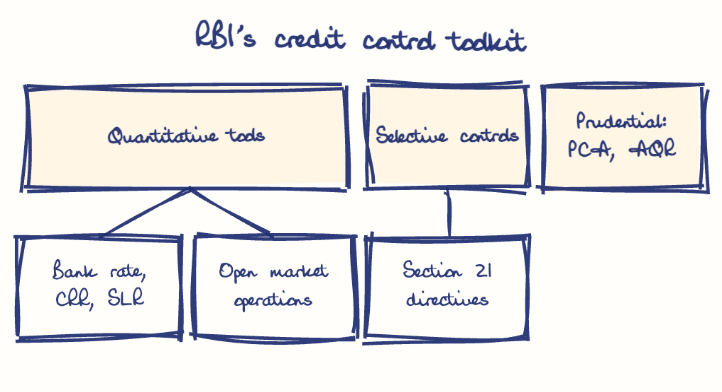
The RBI controls credit through quantitative tools (CRR, SLR, bank rate, open market operations), selective controls under Section 21 of the Banking Regulation Act and Prompt Corrective Action. These curbed inflation and strengthened banks but slowed credit, and the IL&FS crisis exposed gaps over NBFCs.
Model answer
Ghissu Editorial · Verified 4 Oct 2026 · 294 words
Quantitative Tools
RBI uses CRR, SLR, bank rate, and OMOs to regulate credit volume; raising CRR reduces lending capacity, controlling inflation. Open Market Operations also help manage liquidity by buying or selling government securities.
Selective Credit Controls
Section 21 directives and the Credit Authorisation Scheme ensure credit targets productive sectors, limiting speculative loans. These controls help direct credit flow to priority sectors, preventing misuse and financial instability.
NBFC Challenges
IL&FS crisis exposed NBFC vulnerabilities, revealing gaps in RBI’s regulatory reach and affecting credit availability in Andhra Pradesh. The crisis highlighted the need for enhanced oversight of NBFCs to prevent systemic risks and ensure stable credit flow.
Macroeconomic Stability
RBI’s credit control supports inflation targeting by curbing excessive credit growth. Since adopting inflation targeting in 2016, RBI’s calibrated credit measures have helped maintain price stability.
Financial Inclusion
Initiatives like Priority Sector Lending4 and Digital Lending Guidelines expand credit access, yet formal credit penetration remains low nationally and in Andhra Pradesh. The Account Aggregator framework further promotes transparency and access to credit for underserved sectors.
This model answer is indicative and the model can make mistakes; please verify key facts independently.
Practise this question
1Get the answer sheet
Sized for this question.
2Write your answer
Timed, by hand.
3Get it marked
Your score and what to fix.
This chapter in the exam
Resource Mobilization in Indian Economy19 questions
Asked in 7 of 8 sittings since 2008
Most tested: Public debt and its sustainability in post-reform India.
- 2025Differentiate between internal and external public debt. Explain their relative advantages and risks for a developing country like India.
- 2025Discuss the key instruments of Monetary Policy (RBI) and Fiscal Policy in India and evaluate their role in resource mobilisation and inflation management.
All 19 questions, sorted by sub-topic, with model answers and practice.
Question from the official APPSC Group-I Mains 2011 paper. Answer written by Ghissu's engine and checked against our editorial standards. Found an error? Tell us and we correct it within 48 hours.