Discuss the important anti-poverty programmes implemented by the Government of India
In short
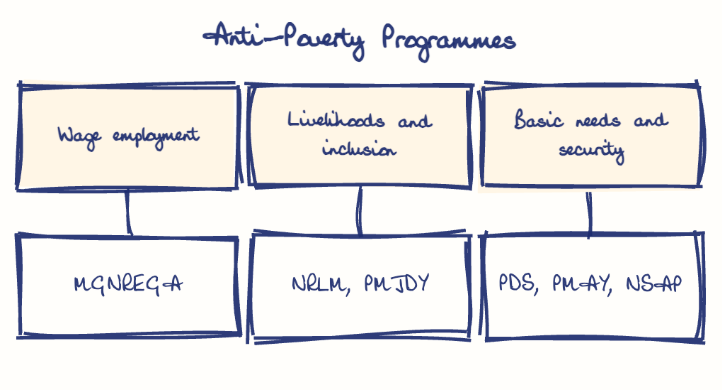
India's main anti-poverty programmes are MGNREGA for rural wage work, NRLM for self-help groups, PM Jan Dhan Yojana for financial inclusion, the PDS for food security, PMAY for housing and NSAP pensions. Together they helped cut multidimensional poverty from 29.17% in 2013-14 to 11.28% in 2022-23.
Model answer
Ghissu Editorial · Verified 4 Oct 2026 · 240 words
India’s anti-poverty programmes have driven down multidimensional poverty1 from 29.17%2 in 2013-14 to 11.28% in 2022-23, supporting SDG 1.
Key Anti-Poverty Programmes
1. MGNREGA’s Role: Provides 100 days of rural employment, crucial for income security and reducing distress migration; demand rose 30% during COVID-19, though Andhra Pradesh3 shows implementation gaps. 2. Financial Inclusion through PMJDY: Over 55 crore bank accounts opened, facilitating direct benefit transfers and credit access; pandemic surge highlights its safety net role. 3. Social Security and Housing: NSAP offers pensions; PMAY targets affordable housing; however, incomplete rehabilitation of families displaced by Andhra Pradesh’s Polavaram Project4 shows execution flaws. 4. Public Distribution System (PDS): Ensures subsidized food grains, vital for food security despite leakage issues.
Audit Reports in Andhra Pradesh
CAG audit reveals ₹968 crore excess payments, welfare fund diversion, and poor compliance in urban local bodies’ solid waste management.
Convergence and Coverage Issues
Lack of coordination among schemes and bureaucratic hurdles exclude many poor from benefits.
Strengthen Monitoring
Use technology and independent audits to improve transparency, especially in Andhra Pradesh.
Enhance Scheme Integration
Coordinate programmes for holistic poverty alleviation.
Expand Funding and Coverage
Ensure full entitlements and extend social security to informal workers.
Promote Sustainable Livelihoods
Scale NRLM and urban missions focusing on skill development and entrepreneurship.
This model answer is indicative and the model can make mistakes; please verify key facts independently.
Practise this question
1Get the answer sheet
Sized for this question.
2Write your answer
Timed, by hand.
3Get it marked
Your score and what to fix.
This chapter in the exam
Inclusive Growth: India and AP schemes49 questions
Asked in 8 of 8 sittings since 2008
Most tested: Women empowerment and poverty reduction through AP welfare and credit-linked institutions
- 2025Elaborate on the meaning of Inclusive Growth in the context of the Indian economy. Discuss the key strategies and instruments that can be employed to foster greater inclusion and ensure that the benefits of economic growth reach all sections of society.
- 2025Critically Examine the major poverty alleviation and employment generation programmes in India. How effective have they been in addressing rural and urban poverty?
All 49 questions, sorted by sub-topic, with model answers and practice.
Question from the official APPSC Group-I Mains 2011 paper. Answer written by Ghissu's engine and checked against our editorial standards. Found an error? Tell us and we correct it within 48 hours.