Discuss the strategies for wasteland reclamation.
In short
Wasteland reclamation needs a combined strategy: legal protection against new degradation, technical treatment and agroforestry suited to saline, ravinous or mining-affected land, and community ownership through gram panchayats and SHGs. MGNREGA funds and remote sensing support it, as about 17% of India is wasteland per the 2019 Wastelands Atlas.
Model answer
Ghissu Editorial · Verified 4 Oct 2026 · 277 words
Central-State Coordination
The Department of Land Resources and National Remote Sensing Centre guide national efforts; Andhra Pradesh’s Department of Agriculture aligns state programs with national policies. This coordination ensures effective mapping, planning, and implementation of reclamation projects.
Legal and Financial Support
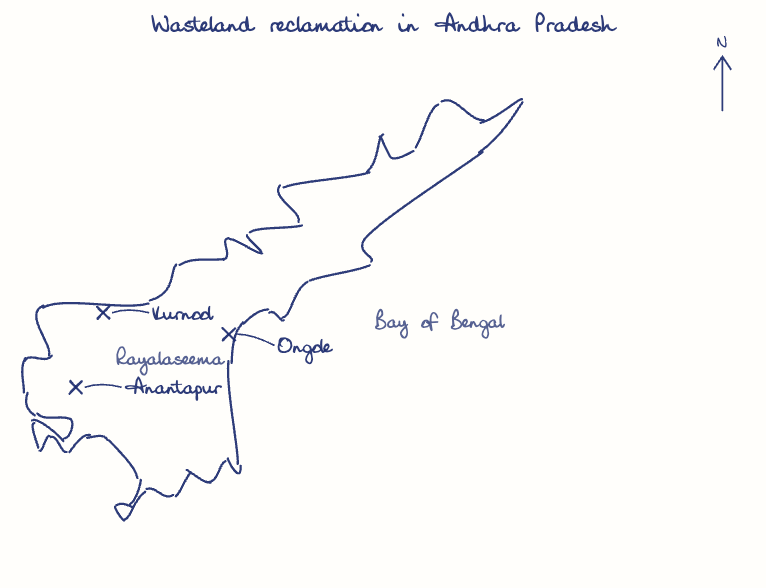
Environmental laws like the Forest Conservation Act and schemes such as the National Agroforestry Policy (2014) and MGNREGA fund reclamation projects in districts like Anantapur and Kurnool. Additionally, the National Watershed Development Project supports soil and water conservation, enhancing resource use efficiency.
Tailored Techniques for Diverse Wastelands
Saline soils in Prakasam require gypsum amendments; ravinous lands in Rayalaseema need structural conservation; agroforestry enhances soil health and biodiversity in Andhra Pradesh’s agro-climatic zones. Multipurpose tree species improve carbon sequestration and provide livelihood options.
Strengthen Institutions and Community Roles
Enhance coordination among state bodies and empower local groups with land rights and incentives. Capacity building of gram panchayats and integration of customary land tenure systems can improve participation and sustainability.
Leverage Technology and Climate Resilience
Use precision agroforestry and integrate reclamation with climate adaptation in vulnerable areas like Rayalaseema. Expanding soil health card usage and remote sensing can optimize resource allocation and monitor progress effectively.
This model answer is indicative and the model can make mistakes; please verify key facts independently.
Practise this question
1Get the answer sheet
Sized for this question.
2Write your answer
Timed, by hand.
3Get it marked
Your score and what to fix.
This chapter in the exam
Development vs Environment: natural resources, climate change, EIA, natural disasters48 questions
Asked in 8 of 8 sittings since 2008
Most tested: Climate change and mining/environmental degradation links
- 2025Explain the different types of natural resources in India. How are they being conserved through government initiatives?
- 2025Investigate the relationship between mining activities and the occurrence of earthquakes. Explain how mining operations can be regulated to minimize seismic risks.
All 48 questions, sorted by sub-topic, with model answers and practice.
Question from the official APPSC Group-I Mains 2011 paper. Answer written by Ghissu's engine and checked against our editorial standards. Found an error? Tell us and we correct it within 48 hours.