Explain Integrated Water Resource Management. Give the importance of Water user Associations.
In short
Integrated Water Resource Management is the coordinated development and management of water, land and related resources to maximise welfare equitably without harming ecosystems. Water User Associations, farmer-led bodies formed under programmes like CAD&WM in Andhra Pradesh, make it work locally by sharing water fairly, collecting charges and maintaining canals.
Model answer
Ghissu Editorial · Verified 4 Oct 2026 · 250 words
Policy Support
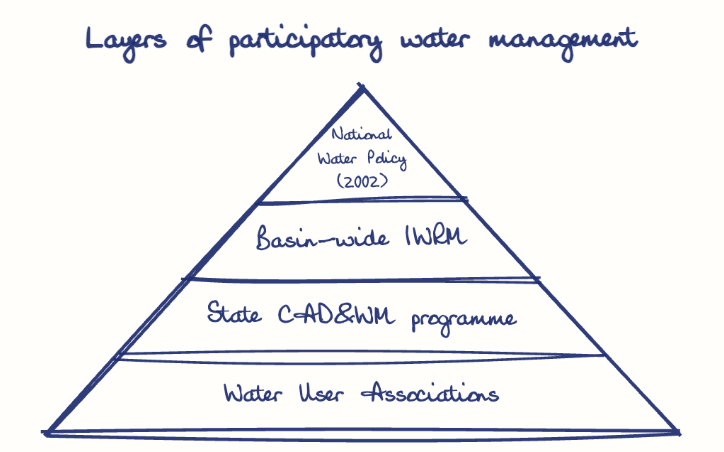
The National Water Policy (2002) advocates decentralised participatory management involving Panchayats and WUAs for planning, operation, and maintenance of water infrastructure, fostering ownership and accountability at the user level.
Local Empowerment
WUAs are farmer-led cooperatives managing water distribution, conflict resolution, and maintenance, fostering ownership and efficiency. They enable collective decision-making and improve system sustainability.
Equity and Sustainability
They ensure fair water allocation, especially in Andhra Pradesh’s Rayalaseema drought-prone region, addressing small farmers’ concerns. WUAs also recover water charges to fund infrastructure upkeep, reducing dependence on subsidies.
Legal and Capacity Strengthening
Updating WUA laws in states like Andhra Pradesh and conducting regular training on water budgeting, conflict resolution, and modern irrigation techniques will enhance their effectiveness and sustainability.
Technology Integration
Digital tools for water metering, monitoring, and data sharing can improve transparency, adaptive management, and support government schemes like Pradhan Mantri Krishi Sinchayee Yojana (PMKSY).
This model answer is indicative and the model can make mistakes; please verify key facts independently.
Practise this question
1Get the answer sheet
Sized for this question.
2Write your answer
Timed, by hand.
3Get it marked
Your score and what to fix.
This chapter in the exam
Development vs Environment: natural resources, climate change, EIA, natural disasters48 questions
Asked in 8 of 8 sittings since 2008
Most tested: Climate change and mining/environmental degradation links
- 2025Explain the different types of natural resources in India. How are they being conserved through government initiatives?
- 2025Investigate the relationship between mining activities and the occurrence of earthquakes. Explain how mining operations can be regulated to minimize seismic risks.
All 48 questions, sorted by sub-topic, with model answers and practice.
Question from the official APPSC Group-I Mains 2011 paper. Answer written by Ghissu's engine and checked against our editorial standards. Found an error? Tell us and we correct it within 48 hours.