Give an account on mineral resources of India. Explain the impacts of mining activity on the environment.
In short
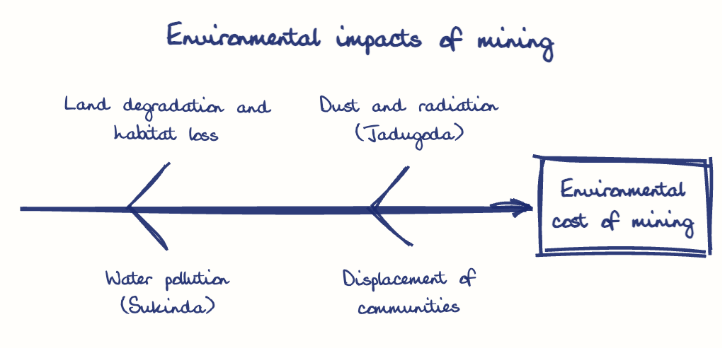
India produces about 95 minerals, from iron ore, bauxite and coal to mica and graphite, though mining adds only about 1.4% to GDP. Mining degrades land and habitats, pollutes water and air and displaces people, as seen in chromium pollution at Sukinda and radiation risks near Jadugoda.
Model answer
Ghissu Editorial · Verified 4 Oct 2026 · 263 words
Diverse and Strategic Mineral Wealth
India produces about 95 minerals, including iron ore, bauxite, and manganese; Andhra Pradesh1 holds 86.11% of barytes reserves and 18.49% of road metal reserves, underscoring regional importance and the need for focused resource management.
Ecological and Health Hazards
Mining causes land degradation, habitat loss, water pollution (e.g., hexavalent chromium contamination in Sukinda), and air pollution with occupational hazards such as radioactive exposure near Jadugoda Uranium mines, threatening biodiversity and public health.
Social and Regulatory Challenges
Coal mining in Jharkhand4 affects indigenous communities through displacement; audits of Andhra Pradesh mines highlight revenue and compliance gaps; governance reforms are urged by the Standing Committee on Coal, Mines, and Steel5 to improve transparency and rehabilitation.
Sustainable Practices and Governance
Strengthening Environment Management Plans, promoting mineral recycling of metals like aluminum and copper, and enhancing regulatory coordination between central and state agencies are vital for sustainable mining and conservation.
This model answer is indicative and the model can make mistakes; please verify key facts independently.
Practise this question
1Get the answer sheet
Sized for this question.
2Write your answer
Timed, by hand.
3Get it marked
Your score and what to fix.
This chapter in the exam
Development vs Environment: natural resources, climate change, EIA, natural disasters48 questions
Asked in 8 of 8 sittings since 2008
Most tested: Climate change and mining/environmental degradation links
- 2025Explain the different types of natural resources in India. How are they being conserved through government initiatives?
- 2025Investigate the relationship between mining activities and the occurrence of earthquakes. Explain how mining operations can be regulated to minimize seismic risks.
All 48 questions, sorted by sub-topic, with model answers and practice.
Question from the official APPSC Group-I Mains 2011 paper. Answer written by Ghissu's engine and checked against our editorial standards. Found an error? Tell us and we correct it within 48 hours.