(i) Illustrate the National Policy on Science and Technology. (ii) Discuss the role of technology missions in India with a suitable example.
In short
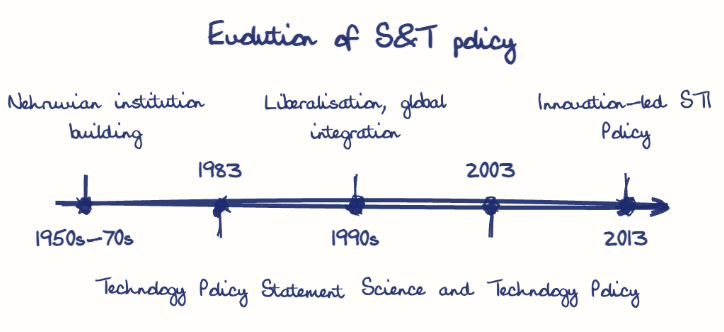
India's science and technology policy evolved from the Scientific Policy Resolution 1958 and the Technology Policy Statement 1983 to the 2003 and 2013 policies stressing innovation-led growth and stronger R&D. Technology missions turn policy into focused results, as the 1986 Technology Mission on Oilseeds drove the Yellow Revolution.
Model answer
Ghissu Editorial · Verified 4 Oct 2026 · 250 words
Phased Development
India’s S&T policy progressed from Nehruvian institution-building (1950s-70s) to the 1983 Technology Policy2 promoting indigenous development, and the 2003 and 2013 NPST emphasizing innovation-led growth and academia-industry collaboration.
State-Level Capacity
Andhra Pradesh benefits from institutions like IIT Tirupati and the Sriharikota spaceport, supporting national missions and regional development in sectors like aquaculture and horticulture.
Sectoral Focus
Missions target critical areas; the Technology Mission on Oilseeds drove the Yellow Revolution, benefiting groundnut farmers in regions like Rayalaseema, while the India Semiconductor Mission is building domestic chip capacity, including a unit in Andhra Pradesh, enhancing technological sovereignty.
Governance and Challenges
DST and the National Research Foundation coordinate funding and policy, but India’s R&D expenditure (~0.65% GDP) and technology transfer remain limited, requiring stronger public-private partnerships and commercialization efforts.
Strengthen Innovation Ecosystems
Boost funding and institutional support in states like Andhra Pradesh to leverage local strengths.
Promote Partnerships and Commercialization
Develop incentives for private sector involvement and establish value addition centres to improve market adoption.
This model answer is indicative and the model can make mistakes; please verify key facts independently.
Practise this question
1Get the answer sheet
Sized for this question.
2Write your answer
Timed, by hand.
3Get it marked
Your score and what to fix.
This chapter in the exam
Science, Technology & Innovation: policies, institutions, achievements20 questions
Asked in 7 of 8 sittings since 2008
Most tested: Science and technology policy and mission-mode institutions
- 2025Evaluate the impact of Internet of Things (IoT) technologies on the automation of household systems. Illustrate how everyday tasks have evolved due to IoT innovations.
- 2025Which are the major scientific institutes located in Andhra Pradesh? Discuss the role of IISER Tirupati in the scientific and educational development of the state.
All 20 questions, sorted by sub-topic, with model answers and practice.
Question from the official APPSC Group-I Mains 2011 paper. Answer written by Ghissu's engine and checked against our editorial standards. Found an error? Tell us and we correct it within 48 hours.