Discuss about the various stages of British colonialism and its impact on Indian Society.
In short
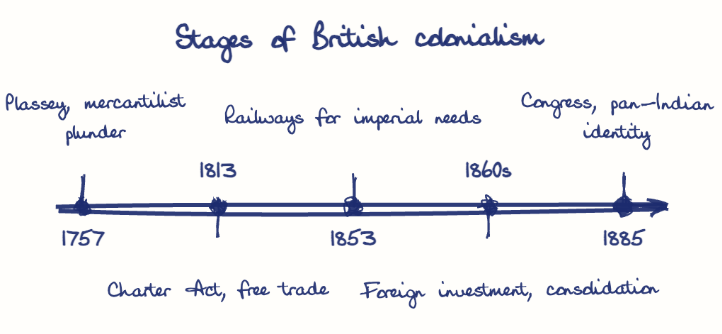
British colonialism passed through a mercantilist phase after Plassey in 1757, a free-trade industrial capitalist phase after the Charter Act of 1813, and an imperial consolidation phase from the 1860s. It caused deindustrialisation, agrarian distress and the drain of wealth, but also sparked social reform and modern nationalism.
Model answer
Ghissu Editorial · Verified 4 Oct 2026 · 310 words
Free Trade and Industrial Capitalism (1813-1858)
The Charter Act (1813) opened India to British manufactured goods, transforming it into a supplier of raw materials and a captive market. Indigenous industries, especially textiles, were devastated, causing widespread artisan unemployment and deindustrialisation.
Imperial Consolidation (1860s onwards)
Britain intensified control, expanding bureaucracy and military presence. Infrastructure projects like the Indian Railways1 (initiated in 1853) primarily served imperial economic interests, facilitating resource extraction and troop movement, while also integrating the Indian economy into the global capitalist system.
Economic Exploitation and Rural Distress
Revenue systems such as the Permanent Settlement and Ryotwari imposed heavy burdens on peasants, leading to agrarian crises and famines. Dadabhai Naoroji’s drain of wealth theory highlighted how colonial policies impoverished India while enriching Britain, exacerbating rural indebtedness and social distress.
Political Mobilization and Nationalism
The unification of India under British rule fostered a pan-Indian identity. The Indian National Congress, formed in 1885, became a platform for nationalist demands, evolving from moderate petitions to assertive calls for swaraj, inspired by leaders like Dadabhai Naoroji and Bal Gangadhar Tilak.
Addressing Inequality
Focus on rural development, agrarian reforms, and revival of traditional crafts to redress colonial-era economic disruptions and reduce wealth concentration.
This model answer is indicative and the model can make mistakes; please verify key facts independently.
Sources
Practise this question
1Get the answer sheet
Sized for this question.
2Write your answer
Timed, by hand.
3Get it marked
Your score and what to fix.
This chapter in the exam
British Rule 1757-1856, the 1857 Revolt, Socio-Religious Reform & the Rise of Nationalism20 questions
Asked in 8 of 8 sittings since 2008
Most tested: Colonialism’s impact on Indian society/economy and reform-led social uplift, especially untouchability and caste reform.
- 2025What do you understand by the Permanent Settlement, and what impact did it have on Indian society? Comment.
- 2025What do you understand by the 'safety valve' theory? Explain it in the context of the Indian National Congress?
All 20 questions, sorted by sub-topic, with model answers and practice.
Question from the official APPSC Group-I Mains 2012 paper. Answer written by Ghissu's engine and checked against our editorial standards. Found an error? Tell us and we correct it within 48 hours.