Estimate the role of women in the National Movement. Do you consider that their participation was an indication for the women empowerment in those days?
In short
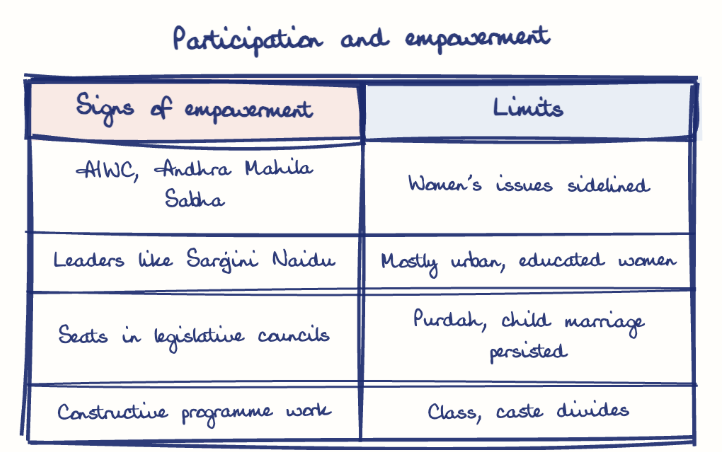
Women played a crucial role in the National Movement through bodies like the All India Women's Conference and leaders like Sarojini Naidu and Durgabai Deshmukh, founder of the Andhra Mahila Sabha (1937). Their participation signalled only partial empowerment, as women's own issues were subordinated and patriarchal practices persisted.
Model answer
Ghissu Editorial · Verified 4 Oct 2026 · 248 words
Women’s Organisations
The All India Women’s Conference (1927) and Bharat Stri Mahamandal (1910) provided platforms linking women’s rights with nationalism.
Key Leaders
Sarojini Naidu, Kasturba Gandhi, and Annie Besant led protests, and Durgabai Deshmukh founded the Andhra Mahila Sabha (1937), empowering women socially and politically.
Subordination of Women’s Issues
Women’s concerns were often secondary to national goals; many leaders preferred apolitical women’s groups to gain British support.
Fragmented Participation
Class, caste, and religious divides limited a unified feminist agenda, with rural women less represented.
Educational Advances
The movement inspired women’s schools, improving literacy and skills, foundational for empowerment.
Political Legacy
Participation influenced constitutional equality and policies like the 73rd Amendment reserving Panchayati Raj1 seats for women.
Economic Roles
Women’s involvement in village industries began challenging traditional economic roles.
Inclusive Mobilisation
Address caste, class, and religious disparities for unified empowerment.
Political Representation
Expand policies like Nari Shakti Vandan Adhiniyam for greater legislative participation.
Education and Skills
Invest in rural and marginalized women’s training.
This model answer is indicative and the model can make mistakes; please verify key facts independently.
Sources
Practise this question
1Get the answer sheet
Sized for this question.
2Write your answer
Timed, by hand.
3Get it marked
Your score and what to fix.
This chapter in the exam
Indian Nationalism in Three Phases; Independence, Partition and After22 questions
Asked in 8 of 8 sittings since 2008
Most tested: Gandhian mass movements and their impact, alongside peasant mobilisation and communalism/partition.
- 2025Discuss the role and contributions of the moderate leaders of Congress from 1885 to 1905.
- 2025Describe the major movements led by Mahatma Gandhi between 1920 and 1947.
All 22 questions, sorted by sub-topic, with model answers and practice.
Question from the official APPSC Group-I Mains 2012 paper. Answer written by Ghissu's engine and checked against our editorial standards. Found an error? Tell us and we correct it within 48 hours.