Explain the main features of the religious and social reform movements and evaluate their role in the making of Modern India.
In short
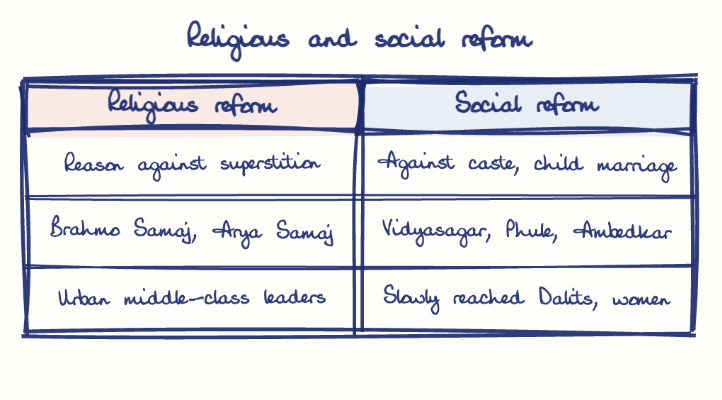
Religious and social reform movements combined rationalism and universalism with attacks on caste, sati, child marriage and women's subordination, led largely by an educated urban middle class. They laid modern India's intellectual foundations, as when Raja Ram Mohan Roy's Brahmo Samaj helped abolish sati in 1829.
Model answer
Ghissu Editorial · Verified 4 Oct 2026 · 282 words
Rationalism and Humanism
Raja Ram Mohan Roy2’s Brahmo Samaj promoted monotheism and campaigned successfully for the abolition of sati (1829); Arya Samaj3, led by Dayanand Saraswati, revived Vedic religion rejecting later corruptions. Swami Vivekananda emphasized human welfare and universal spirituality, inspiring national pride.
Social Evils and Secular Ethos
Jyotirao Phule and Ishwar Chandra Vidyasagar fought caste discrimination, child marriage, and promoted female education; B.R. Ambedkar’s fight against caste emphasized constitutional morality and human rights. These efforts targeted entrenched social hierarchies.
Expansion and Media Use
Movements broadened to include Dalits and women, using vernacular media like Telugu journalism and Brahmo Samaj branches in Andhra for social awakening. This helped link social reform with the nationalist movement, increasing mass participation.
Limitations and Balanced Modernization
Movements were often elitist and limited in rural reach; some revivalist tendencies reinforced religious particularism. Reformers integrated scientific ideas with indigenous culture, avoiding blind Western imitation, thus shaping a unique Indian modernity.
This model answer is indicative and the model can make mistakes; please verify key facts independently.
Practise this question
1Get the answer sheet
Sized for this question.
2Write your answer
Timed, by hand.
3Get it marked
Your score and what to fix.
This chapter in the exam
British Rule 1757-1856, the 1857 Revolt, Socio-Religious Reform & the Rise of Nationalism20 questions
Asked in 8 of 8 sittings since 2008
Most tested: Colonialism’s impact on Indian society/economy and reform-led social uplift, especially untouchability and caste reform.
- 2025What do you understand by the Permanent Settlement, and what impact did it have on Indian society? Comment.
- 2025What do you understand by the 'safety valve' theory? Explain it in the context of the Indian National Congress?
All 20 questions, sorted by sub-topic, with model answers and practice.
Question from the official APPSC Group-I Mains 2012 paper. Answer written by Ghissu's engine and checked against our editorial standards. Found an error? Tell us and we correct it within 48 hours.