Explain the social structure during the Satavahana period and also discuss the contribution of Satavahanas to the society.
In short
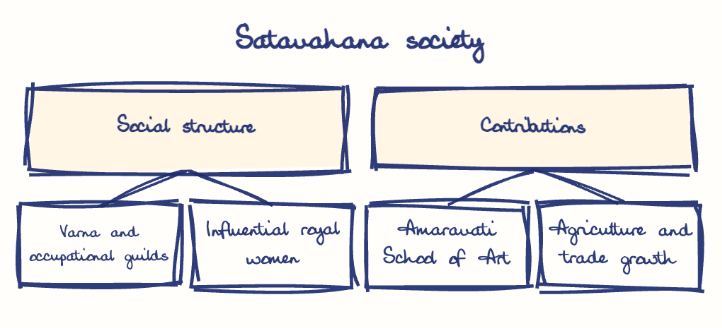
Satavahana society combined the four-fold varna order with occupational guilds (srenis), gave women like Naganika and Gautami Balasri unusual status, and blended Brahmanism with Buddhism. The dynasty contributed land grants, trade, coinage, rock-cut caves at Nashik and Kanheri, and the Amaravati School of Art.
Model answer
Ghissu Editorial · Verified 4 Oct 2026 · 268 words
Caste and Occupational Guilds
Society integrated the four-fold Varna system with occupational groups like Halika (cultivators), Sethi (merchants), and Kamara (blacksmiths), forming guilds (srenis) that balanced caste hierarchy and economic roles.
Religious Pluralism
The Satavahanas patronized Brahmanism and Buddhism, granting land to monks and supporting Buddhist centers like Amaravati, facilitating social integration including foreign tribes like the Sakas.
Local Governance and Guilds
Villages (gramas) managed by gramani and merchant corporations (Nigamasabha) fostered economic stability and civic participation in Andhra Pradesh.
Religious Patronage and Cultural Synthesis
Their support for Vedic rituals coexisted with Buddhist land grants, enriching India’s spiritual heritage through centers like Amaravati.
Art and Architecture Innovations
Pioneered rock-cut chaityas and viharas in Nashik and Kanheri; developed the Amaravati School of Art known for marble sculptures and stupas.
Economic Development and Trade
Stimulated agriculture via land grants and irrigation; merchant guilds and coinage boosted trade across the Deccan.
Administrative Innovations
Combined Mauryan administrative practices with local military governance and tax-free religious villages, influencing later South Indian polities.
Heritage Conservation
Enhance preservation of Satavahana sites like Amaravati and Nagarjunakonda through funding and community engagement.
Inclusive Research
Promote interdisciplinary studies on caste, gender, and religion during the Satavahana period in Andhra Pradesh.
This model answer is indicative and the model can make mistakes; please verify key facts independently.
Sources
Practise this question
1Get the answer sheet
Sized for this question.
2Write your answer
Timed, by hand.
3Get it marked
Your score and what to fix.
This chapter in the exam
Andhra - Ancient16 questions
Asked in 8 of 8 sittings since 2008
Most tested: Satavahana socio-religious and cultural life, especially society, religion, and literature.
- 2025How did far trade routes contribute to the exchange of Buddhist ideas in ancient Andhra?
- 2025What are the various stories about the origins of Andhra people and the Andhra language?
All 16 questions, sorted by sub-topic, with model answers and practice.
Question from the official APPSC Group-I Mains 2012 paper. Answer written by Ghissu's engine and checked against our editorial standards. Found an error? Tell us and we correct it within 48 hours.