Give a detailed account of Harappans' town planning and evaluate the various reasons for its decline.
In short
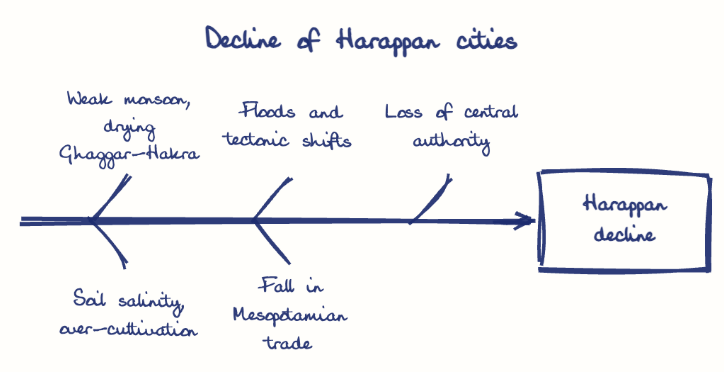
Harappan towns were built on precise grids with standardised baked bricks, covered drains, citadel and lower-town zoning, granaries and wells, showing centralised civic control. Their decline resulted from a weakening monsoon, drying of the Ghaggar-Hakra, ecological degradation, floods, collapsing Mesopotamian trade and loss of central authority.
Model answer
Ghissu Editorial · Verified 4 Oct 2026 · 345 words
Grid-Based City Layout and Standardized Bricks
Cities like Mohenjodaro and Dholavira featured precise grid systems with streets intersecting at right angles and uniform baked bricks, showing centralized planning and resource management that ensured durable, uniform construction.
Advanced Drainage and Water Systems
Covered drainage connected to houses and water harvesting techniques, including wells and reservoirs, ensured sanitation and reliable water supply, crucial for sustaining dense populations in the semi-arid Indus valley.
Zoning and Public Utilities
Urban areas were divided into citadels and lower towns, with specialized structures like the Great Bath and granaries indicating organized communal functions and surplus food storage.
Climatic Change
A weakening monsoon and drying of the Ghaggar-Hakra river system caused agricultural decline and water scarcity, undermining the economic base.
Ecological Degradation and Natural Disasters
Over-cultivation, deforestation and flooding (evidenced by silt layers and collapsed structures at Mohenjodaro) disrupted urban life and trade routes, while tectonic shifts altered river courses.
Economic and Sociopolitical Factors
Decline in trade with Mesopotamia and the loss of central authority led to the abandonment of core cities for smaller settlements, though evidence of invasion remains inconclusive.
This model answer is indicative and the model can make mistakes; please verify key facts independently.
Practise this question
1Get the answer sheet
Sized for this question.
2Write your answer
Timed, by hand.
3Get it marked
Your score and what to fix.
This chapter in the exam
Ancient India - Pre-history, IVC, Vedic, Mauryas, Kushans, Satavahanas, Sangam, Guptas16 questions
Asked in 8 of 8 sittings since 2008
Most tested: Harappan civilisation—urban planning, origin/decline, and continuity.
- 2025Discuss the origin and expansion of the Indus Valley Civilization.
- 2025Briefly analyze the teachings of Buddha and Mahavira.
All 16 questions, sorted by sub-topic, with model answers and practice.
Question from the official APPSC Group-I Mains 2012 paper. Answer written by Ghissu's engine and checked against our editorial standards. Found an error? Tell us and we correct it within 48 hours.