Give an account of the socio-cultural and religious conditions of the people after the down fall of Satavahana dynasty.
In short
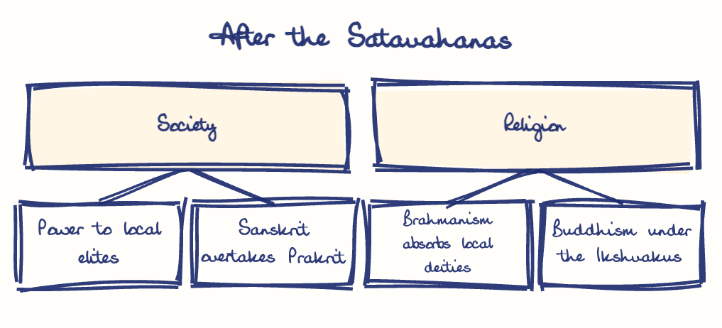
After the Satavahana decline, political power fragmented among local feudatories, Sanskrit displaced Prakrit while early Telugu and Kannada emerged, and varna persisted while absorbing local customs. Religion became syncretic: Brahmanism adapted, and Mahayana Buddhism flourished at Nagarjunakonda under the Ikshvakus alongside a marginal Jainism.
Model answer
Ghissu Editorial · Verified 4 Oct 2026 · 253 words
Fragmented Political Authority
Post-Satavahana, local feudatories and governors asserted independence, decentralizing power to village elites and landlords. The village became the basic administrative unit, empowering local elites and creating multiple small power centers.
Brahmanism and Buddhism
Brahmanism declined centrally but adapted by integrating local customs and deities, sustaining its influence through reforms and land grants. Buddhism, especially Mahayana, flourished at Nagarjunakonda under Ikshvakus, supported by merchant and artisan communities, indicating religious pluralism.
Religious Syncretism
Mutual accommodation among Brahmanism, Buddhism, and Jainism was evident in shared rituals, land grants, and blended iconography, fostering tolerance. Jainism, though less patronized, continued peacefully in border regions, contributing to the religious mosaic.
Heritage and Education
Conservation of Amaravati and Nagarjunakonda monuments and promoting multilingual education, including Telugu and Sanskrit, can preserve cultural memory and linguistic heritage rooted in this historical transition.
Interfaith Dialogue
Institutionalizing platforms in Andhra Pradesh for dialogue among religious communities can revive the historical tradition of religious tolerance and syncretism, strengthening social harmony.
This model answer is indicative and the model can make mistakes; please verify key facts independently.
Practise this question
1Get the answer sheet
Sized for this question.
2Write your answer
Timed, by hand.
3Get it marked
Your score and what to fix.
This chapter in the exam
Andhra - Ancient16 questions
Asked in 8 of 8 sittings since 2008
Most tested: Satavahana socio-religious and cultural life, especially society, religion, and literature.
- 2025How did far trade routes contribute to the exchange of Buddhist ideas in ancient Andhra?
- 2025What are the various stories about the origins of Andhra people and the Andhra language?
All 16 questions, sorted by sub-topic, with model answers and practice.
Question from the official APPSC Group-I Mains 2012 paper. Answer written by Ghissu's engine and checked against our editorial standards. Found an error? Tell us and we correct it within 48 hours.