How far have the oppressed caste movements and their leaders helped the downtrodden people for their upliftment?
In short
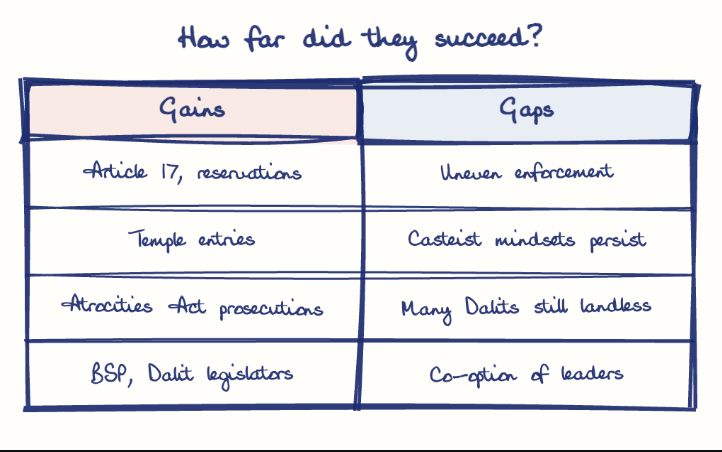
Oppressed caste movements and their leaders substantially helped the downtrodden by building awareness, legal rights, education and political voice, though economic and social inequality persists. Ambedkar secured the abolition of untouchability under Article 17 and reservations, while in Andhra the Adi-Andhra Mahasabha and leaders like Jala Rangaswamy spread Dalit education.
Model answer
Ghissu Editorial · Verified 4 Oct 2026 · 269 words
Dalit Women Leaders1’ Intersectional Struggles
Dalit women leaders address layered discrimination, notably in water justice and gender-based violence, highlighting the need for inclusive activism that tackles both caste and gender oppression simultaneously.
Ambedkar’s Constitutional Vision
He secured abolition of untouchability (Article 17) and reservations in education and employment, laying a legal foundation for Dalit upliftment and political representation.
Political Mobilization and Challenges
Dalit parties like the Bahujan Samaj Party increased political representation, but the co-option of Dalit leaders by dominant-caste-led parties limits their transformative potential and autonomy.
Legal Enforcement and Pro Bono Services
Despite laws like the SC/ST (Prevention of Atrocities) Act, enforcement gaps persist; pro bono legal aid and stronger implementation mechanisms are vital for marginalized communities to access justice.
Holistic Empowerment
Inclusive policies focusing on education, skill development, and autonomous Dalit leadership are needed to sustain upliftment and counter co-option by dominant castes.
This model answer is indicative and the model can make mistakes; please verify key facts independently.
Practise this question
1Get the answer sheet
Sized for this question.
2Write your answer
Timed, by hand.
3Get it marked
Your score and what to fix.
This chapter in the exam
British Rule 1757-1856, the 1857 Revolt, Socio-Religious Reform & the Rise of Nationalism20 questions
Asked in 8 of 8 sittings since 2008
Most tested: Colonialism’s impact on Indian society/economy and reform-led social uplift, especially untouchability and caste reform.
- 2025What do you understand by the Permanent Settlement, and what impact did it have on Indian society? Comment.
- 2025What do you understand by the 'safety valve' theory? Explain it in the context of the Indian National Congress?
All 20 questions, sorted by sub-topic, with model answers and practice.
Question from the official APPSC Group-I Mains 2012 paper. Answer written by Ghissu's engine and checked against our editorial standards. Found an error? Tell us and we correct it within 48 hours.