What was the impact of the First and Second World Wars on the Indian National Movement?
In short
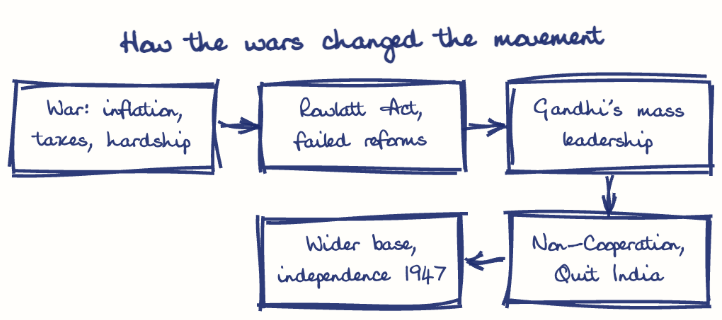
Both World Wars turned the national movement from elite petitioning into mass struggle by causing economic hardship, exposing broken colonial promises and widening the social base. The First War brought the Rowlatt Act, Jallianwala Bagh and Non-Cooperation, while the Second War produced the Quit India Movement.
Model answer
Ghissu Editorial · Verified 4 Oct 2026 · 270 words
Expansion and Disillusionment
The Montagu-Chelmsford Reforms (1919) marginally expanded the electorate but failed nationalist demands, leading to widespread disillusionment with constitutional methods and fueling support for more radical approaches.
Rise of Mass Movements
Gandhi’s leadership during the Khilafat, Non-Cooperation, and Quit India Movements mobilized diverse social groups despite British repression. The Quit India Movement1 (1942) especially demonstrated Congress’s ability to orchestrate nationwide resistance under severe crackdown.
War-Induced Hardships
Inflation, unemployment, and increased taxation during both wars severely affected peasants and workers, intensifying nationalist participation and sparking protests like the 1918 Kheda Satyagraha.
Adaptive Strategies
Failure of wartime promises led to militant strategies like civil disobedience and Quit India, enhancing organizational capacity and political awakening that paved the way for independence.
Inclusive Institutions and Economic Equity
Strengthen political frameworks to integrate diverse social groups and implement policies addressing economic inequalities to sustain democratic participation and social stability.
Communal Harmony and Historical Memory
Promote inter-community dialogue to build unity and institutionalize education on the wars’ impact to inspire future generations about the freedom struggle’s sacrifices and strategies.
This model answer is indicative and the model can make mistakes; please verify key facts independently.
Sources
Practise this question
1Get the answer sheet
Sized for this question.
2Write your answer
Timed, by hand.
3Get it marked
Your score and what to fix.
This chapter in the exam
Indian Nationalism in Three Phases; Independence, Partition and After22 questions
Asked in 8 of 8 sittings since 2008
Most tested: Gandhian mass movements and their impact, alongside peasant mobilisation and communalism/partition.
- 2025Discuss the role and contributions of the moderate leaders of Congress from 1885 to 1905.
- 2025Describe the major movements led by Mahatma Gandhi between 1920 and 1947.
All 22 questions, sorted by sub-topic, with model answers and practice.
Question from the official APPSC Group-I Mains 2012 paper. Answer written by Ghissu's engine and checked against our editorial standards. Found an error? Tell us and we correct it within 48 hours.