Explain the privileges and immunities of legislature under the Constitution of India. How far can the judiciary interfere with such privileges and immunities?
In short
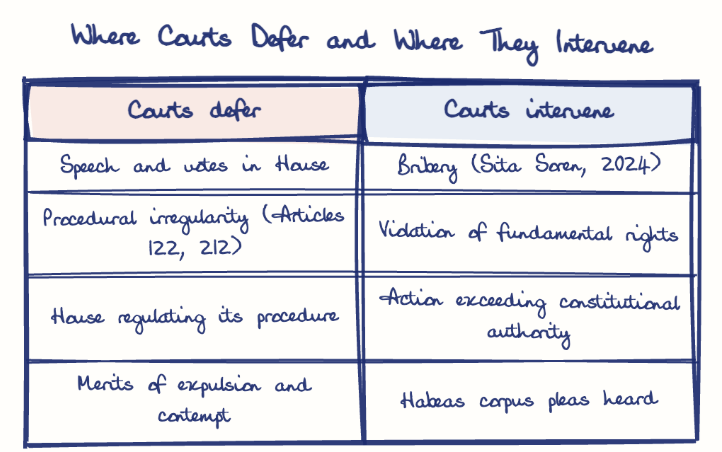
Under Articles 105 and 194, legislators enjoy free speech and votes in the House and civil arrest immunity during sessions, and each House regulates its own proceedings, which courts cannot question on procedural grounds. Courts still intervene when fundamental rights are violated, and Sita Soren (2024) denied immunity for bribery.
Model answer
Ghissu Editorial · Verified 4 Oct 2026 · 262 words
Core Privileges
Articles 105 and 194 provide freedom of speech in the House, immunity from civil arrest during sessions, and the right to regulate proceedings, preserving legislative dignity and autonomy.
Judicial Interpretation
The Supreme Court in Sita Soren (2024) overruled PV Narasimha Rao (1998) and held that privileges give no immunity for bribery, reinforcing that privileges are subject to constitutional limits and fundamental rights.
Scope of Review
Courts apply a two-fold test: privileges must be essential for legislative functions and not infringe fundamental rights; Article 122(1) bars questioning procedural validity but allows intervention if constitutional violations occur, as in Raja Ram Pal v. Hon’ble Speaker (2007).
No Absolute Immunity
Legislators cannot claim immunity from criminal prosecution, as affirmed in the Kerala MLAs case (2021); judicial review protects citizens’ rights against misuse of privileges and ensures accountability.
Criminal Cases Data
43% of MPs in the 17th Lok Sabha have pending criminal cases, up from 34% in the 16th, highlighting the urgency for reform to prevent abuse of privileges.
Reform Proposals
Parliament should codify privileges to enhance clarity and accountability, and establish an independent oversight mechanism similar to the UK’s Committee on Standards to balance legislative autonomy with judicial scrutiny.
This model answer is indicative and the model can make mistakes; please verify key facts independently.
Practise this question
1Get the answer sheet
Sized for this question.
2Write your answer
Timed, by hand.
3Get it marked
Your score and what to fix.
This chapter in the exam
Parliament and State Legislatures13 questions
Asked in 8 of 8 sittings since 2008
Most tested: Comparative powers and status of the two Houses, especially Rajya Sabha vs Lok Sabha and Legislative Council vs Legislative Assembly.
- 2025In what aspects is the Legislative Council (Vidhan Parishad) different from the Rajya Sabha, considering its role at the state level?
- 2025What are the steps followed by the Indian Parliament in transforming a Bill into an Act?
All 13 questions, sorted by sub-topic, with model answers and practice.
Question from the official APPSC Group-I Mains 2012 paper. Answer written by Ghissu's engine and checked against our editorial standards. Found an error? Tell us and we correct it within 48 hours.