What are the Constitutional guarantees given to women? Explain the role of the National Commission for Women in protecting the rights of the women.
In short
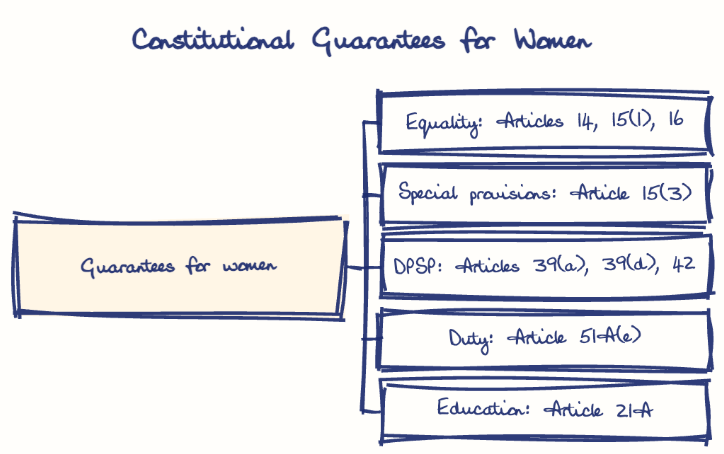
The Constitution guarantees women equality and non-discrimination (Articles 14, 15(1), 16), special provisions (Article 15(3)), equal pay and maternity relief (Articles 39, 42) and a duty to respect their dignity (Article 51A(e)). The NCW (National Commission for Women Act, 1990) monitors these safeguards, redresses complaints and recommends legal reforms.
Model answer
Ghissu Editorial · Verified 4 Oct 2026 · 272 words
Directive Principles and Duties
Articles 39(a), 39(d), and 42 promote equal pay, just working conditions, and maternity benefits; Article 51A(e) imposes a duty to respect women’s dignity, fostering societal change against gender bias.
Right to Education and Health
Article 21A guarantees free and compulsory education for all children, including girls, while other provisions emphasize women’s health and nutrition, essential for their empowerment and socio-economic development.
Monitoring and Legal Redressal
NCW, established under the 1990 Act, monitors constitutional safeguards, addresses complaints on violence and harassment, and pursues compliance with landmark standards such as the Vishaka v. State of Rajasthan3 (1997) guidelines against workplace sexual harassment, later codified in the POSH Act, 2013.
Awareness and Support Services
NCW promotes schemes like One Stop Centres, Women Helpline (181), and Swadhar Greh, and collaborates with state bodies including Andhra Pradesh to enhance outreach. It also conducts legal awareness camps and campaigns against female foeticide and child marriage.
Constitutional Status for NCW
Granting constitutional status would empower NCW with autonomy, civil court powers, and enforceability, enabling stronger protection of women’s rights.
Strengthen State Coordination
Enhanced collaboration with state commissions will improve localized and culturally sensitive implementation of women’s welfare policies.
This model answer is indicative and the model can make mistakes; please verify key facts independently.
Practise this question
1Get the answer sheet
Sized for this question.
2Write your answer
Timed, by hand.
3Get it marked
Your score and what to fix.
This chapter in the exam
Statutory, regulatory, quasi-judicial bodies and Civil Services9 questions
Asked in 6 of 8 sittings since 2008
Most tested: National Commission for Women and quasi-judicial bodies/Administrative Tribunals.
- 2025Under which Act was the National Commission for Women (NCW) established? Describe its main features and limitations.
- 2025Which constitutional provisions empower the formation of quasi-judicial authorities in India? Explain with suitable examples.
All 9 questions, sorted by sub-topic, with model answers and practice.
Question from the official APPSC Group-I Mains 2012 paper. Answer written by Ghissu's engine and checked against our editorial standards. Found an error? Tell us and we correct it within 48 hours.