Which constitutional provisions empower the formation of quasi-judicial authorities in India? Explain with suitable examples.
In short
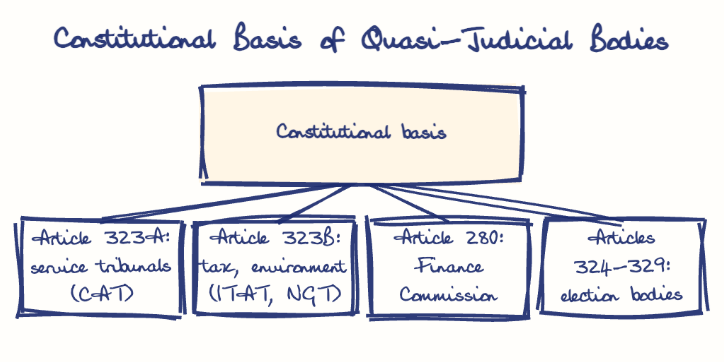
Articles 323A and 323B, added by the 42nd Amendment Act, 1976, empower legislatures to create tribunals for service matters, taxation, industrial disputes and land reforms. The Central Administrative Tribunal (Article 323A) hears service cases of employees including Andhra Pradesh's, and the Election Commission (Articles 324-327) performs quasi-judicial functions too.
Model answer
Ghissu Editorial · Verified 4 Oct 2026 · 288 words
Other Constitutional Bodies
Articles 280, 324-327, and 329 establish constitutional authorities like the Finance Commission and Election Commission with quasi-judicial functions. These bodies adjudicate disputes and regulate sectors under constitutional mandate, ensuring specialized governance.
Legislative and Judicial Framework
Tribunals operate with civil court powers but flexible procedures, enabling expert adjudication; their decisions are subject to judicial review, ensuring accountability. This balance maintains autonomy while upholding natural justice.
Notable Examples
The Central Administrative Tribunal (CAT) under Article 323A handles government service disputes, including in Andhra Pradesh; Article 323B covers tax and other tribunals, while the Income Tax Appellate Tribunal and the National Green Tribunal (NGT, created by Parliament under the NGT Act, 2010) address taxation and environmental issues nationwide, including Andhra Pradesh. State Information Commissions also act as quasi-judicial bodies resolving transparency disputes.
Reforms and Capacity Building
Strengthening tribunal infrastructure and training members in Andhra Pradesh, harmonizing laws to reduce overlaps, and promoting digital adjudication can enhance efficiency. Expanding e-hearings and case management systems will improve accessibility, especially in remote areas.
Uniform Procedural Standards
Implementing consistent procedural norms across tribunals will reduce jurisdictional conflicts and improve public trust in quasi-judicial mechanisms, benefiting states like Andhra Pradesh.
This model answer is indicative and the model can make mistakes; please verify key facts independently.
Practise this question
1Get the answer sheet
Sized for this question.
2Write your answer
Timed, by hand.
3Get it marked
Your score and what to fix.
This chapter in the exam
Statutory, regulatory, quasi-judicial bodies and Civil Services9 questions
Asked in 6 of 8 sittings since 2008
Most tested: National Commission for Women and quasi-judicial bodies/Administrative Tribunals.
- 2025Under which Act was the National Commission for Women (NCW) established? Describe its main features and limitations.
- 2023Explain the quasi-judicial nature of Administrative Tribunals. Examine whether writs and appeals are available against the decisions of the Administrative Tribunals.
All 9 questions, sorted by sub-topic, with model answers and practice.
Question from the official APPSC Group-I Mains 2025 paper. Answer written by Ghissu's engine and checked against our editorial standards. Found an error? Tell us and we correct it within 48 hours.