Under which Act was the National Commission for Women (NCW) established? Describe its main features and limitations.
In short
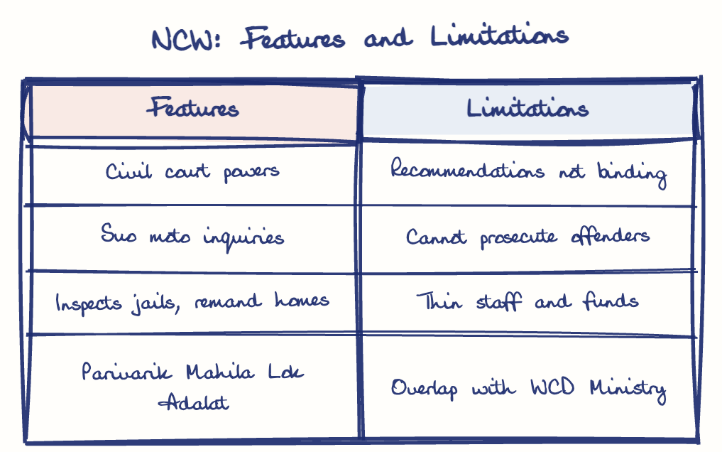
The NCW was established in 1992 under the National Commission for Women Act, 1990, as a statutory body with civil court powers, suo motu cognizance and advisory and inspection roles. Its limitations include non-binding recommendations, no power to prosecute and overlap with the Ministry of Women and Child Development.
Model answer
Ghissu Editorial · Verified 4 Oct 2026 · 240 words
Statutory Establishment
Constituted in 1992 under the National Commission for Women Act, 1990, the NCW has legal authority to investigate and recommend on women’s issues, with members appointed by the Central Government.
Composition and Tenure
It includes a Chairperson, five members, and a Member-Secretary, serving three-year terms to ensure expertise and continuity.
Quasi-Judicial Powers
The NCW can summon witnesses, examine evidence, and take suo moto action on complaints like domestic violence and sexual harassment.
Advisory and Monitoring Role
It advises governments on policy reforms, inspects institutions holding women, and conducts research and advocacy, including initiatives like Parivarik Mahila Lok Adalat.
State-Level Impact
In Andhra Pradesh, NCW supports Mission Shakti2 and One Stop Centres, providing integrated support to women facing violence.
Non-Binding Recommendations
NCW’s advice is not enforceable, limiting its impact on government action.
Limited Enforcement
It cannot prosecute offenders and depends on other agencies, causing delays.
Resource Constraints
Manpower and funding shortages hinder its reach, especially in Andhra Pradesh’s rural and informal sectors.
Overlap and Coordination Issues
Functional overlaps with other bodies dilute its effectiveness.
This model answer is indicative and the model can make mistakes; please verify key facts independently.
Practise this question
1Get the answer sheet
Sized for this question.
2Write your answer
Timed, by hand.
3Get it marked
Your score and what to fix.
This chapter in the exam
Statutory, regulatory, quasi-judicial bodies and Civil Services9 questions
Asked in 6 of 8 sittings since 2008
Most tested: National Commission for Women and quasi-judicial bodies/Administrative Tribunals.
- 2025Which constitutional provisions empower the formation of quasi-judicial authorities in India? Explain with suitable examples.
- 2023Explain the quasi-judicial nature of Administrative Tribunals. Examine whether writs and appeals are available against the decisions of the Administrative Tribunals.
All 9 questions, sorted by sub-topic, with model answers and practice.
Question from the official APPSC Group-I Mains 2025 paper. Answer written by Ghissu's engine and checked against our editorial standards. Found an error? Tell us and we correct it within 48 hours.