Analyse the strategy adopted by Reserve Bank of India to control the rising prices in the last two years.
In short
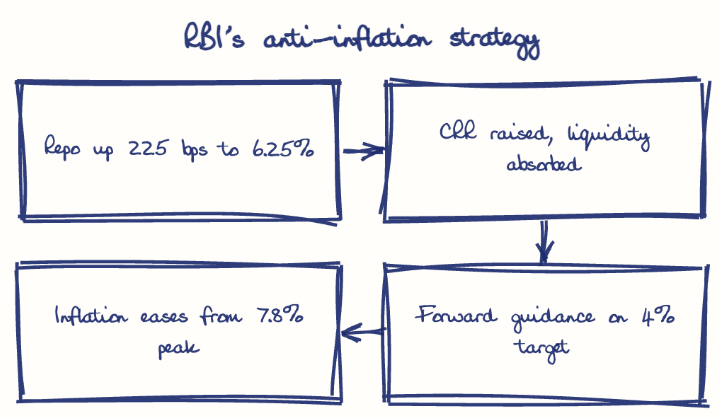
The RBI raised the repo rate by 225 basis points (4.0% to 6.25%) between May and December 2022, raised the CRR and used clear forward guidance. Inflation fell from 7.8% in April 2022 to about 5.7% by December, though supply shocks show tightening alone is not enough.
Model answer
Ghissu Editorial · Verified 4 Oct 2026 · 252 words
Liquidity Management
Raising CRR absorbed excess liquidity, restricting banks’ lending and curbing inflationary money supply.
Selective Credit Controls
Historically used to curb speculative demand, though less prominent recently.
Inflation Moderation
Headline inflation fell from 7.8% (April 2022) to 5.7% (December 2022), showing policy success.
Supply-Side Constraints
Rising crude prices and agricultural variability limited RBI’s demand-side tools, needing government5 intervention.
External Pressures
Rupee depreciation and forex reserve depletion complicated RBI’s policy autonomy.
Supply-Side Reforms
Boost agricultural productivity and infrastructure in Andhra Pradesh (e.g., Polavaram project) to ease food inflation.
Calibrated Monetary Policy
Balance inflation control with growth support, especially for MSMEs in Andhra Pradesh.
Fiscal Discipline
Address Andhra Pradesh’s rising deficits and low capital expenditure to enable growth-supportive investments.
This model answer is indicative and the model can make mistakes; please verify key facts independently.
Practise this question
1Get the answer sheet
Sized for this question.
2Write your answer
Timed, by hand.
3Get it marked
Your score and what to fix.
This chapter in the exam
Resource Mobilization in Indian Economy19 questions
Asked in 7 of 8 sittings since 2008
Most tested: Public debt and its sustainability in post-reform India.
- 2025Differentiate between internal and external public debt. Explain their relative advantages and risks for a developing country like India.
- 2025Discuss the key instruments of Monetary Policy (RBI) and Fiscal Policy in India and evaluate their role in resource mobilisation and inflation management.
All 19 questions, sorted by sub-topic, with model answers and practice.
Question from the official APPSC Group-I Mains 2012 paper. Answer written by Ghissu's engine and checked against our editorial standards. Found an error? Tell us and we correct it within 48 hours.