Examine the relative shares of direct and indirect tax revenues of Indian Government in the post-reforms period.
In short
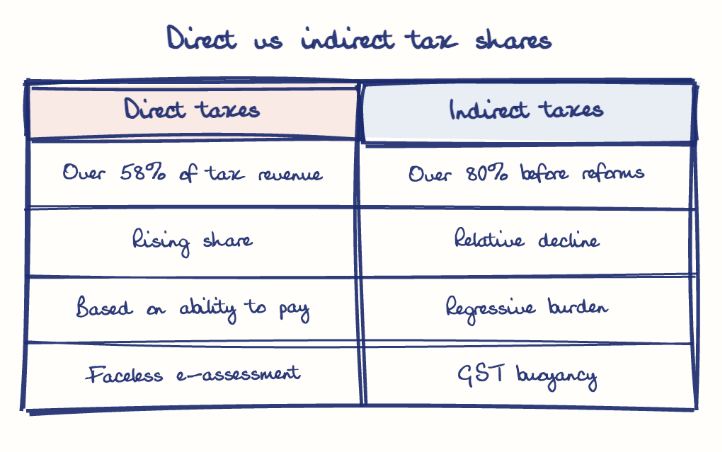
Post-reform, direct taxes rose steadily to over 58% of total tax revenue in the 2024-25 revised estimates, while indirect taxes, over 80% before reforms, fell relatively. The shift, driven by growth, formalisation and better administration, made taxation fairer, while GST kept indirect revenue buoyant.
Model answer
Ghissu Editorial · Verified 4 Oct 2026 · 224 words
Systemic Weaknesses1 Highlighted
The Andhra Pradesh432 CAG audit revealed ₹1,806 crore revenue impact from underassessment in 2021-22, reflecting challenges in tax administration despite reforms like faceless e-assessment and the “Transparent Taxation - Honouring the Honest5” initiative. Pending appeals and arrears remain high, with 97% of uncollected direct tax demand considered difficult to recover, underscoring the need for continued administrative strengthening.
Declining Share but Enhanced Efficiency
Indirect taxes dropped from over 80% pre-reforms; GST collections rose from ₹0.90 lakh crore (FY18) to ₹1.49 lakh crore (FY23), improving revenue buoyancy and market integration by creating a seamless national market and reducing logistics costs.
Complementary Tax Roles
Direct taxes enhance progressivity and are non-inflationary; indirect taxes provide stable revenue and are easier to administer. Reforms seek to balance revenue needs with fairness by rationalizing indirect tax rates and expanding direct tax compliance.
This model answer is indicative and the model can make mistakes; please verify key facts independently.
Practise this question
1Get the answer sheet
Sized for this question.
2Write your answer
Timed, by hand.
3Get it marked
Your score and what to fix.
This chapter in the exam
Resource Mobilization in Indian Economy19 questions
Asked in 7 of 8 sittings since 2008
Most tested: Public debt and its sustainability in post-reform India.
- 2025Differentiate between internal and external public debt. Explain their relative advantages and risks for a developing country like India.
- 2025Discuss the key instruments of Monetary Policy (RBI) and Fiscal Policy in India and evaluate their role in resource mobilisation and inflation management.
All 19 questions, sorted by sub-topic, with model answers and practice.
Question from the official APPSC Group-I Mains 2012 paper. Answer written by Ghissu's engine and checked against our editorial standards. Found an error? Tell us and we correct it within 48 hours.